
In a state known for progressive legislation, California’s stance on kratom might surprise you. While many assume the Golden State has banned this controversial botanical like some of its neighbors, the reality is far more nuanced and continues to evolve with each legislative session.
The legal landscape surrounding kratom in California has been a rollercoaster of proposed bans, regulatory attempts, and ongoing debates. With millions of Americans using kratom for various purposes, understanding the current legal status in the nation’s most populous state is crucial for consumers, retailers, and advocates alike.
- Kratom remains legal at the state level in California as of late 2024, despite multiple attempts to ban it
- Local jurisdictions can impose their own restrictions, creating a patchwork of regulations across the state
- Age restrictions apply in many areas, typically limiting sales to adults 21 and older
- Quality control concerns continue to drive regulatory discussions and potential future legislation
- Federal oversight from the DEA and FDA adds another layer of complexity to kratom’s legal status
Current Legal Status: Is Kratom Legal in California?
Yes, kratom is currently legal in California at the state level. However, this simple answer doesn’t tell the complete story of kratom’s complex legal journey in the Golden State.
California does not have a statewide ban on kratom, meaning adults can legally purchase, possess, and consume kratom products throughout most of the state. This puts California in line with the majority of U.S. states that have chosen not to ban the Southeast Asian botanical.
The Nuanced Reality
While kratom enjoys legal status statewide, several important factors complicate this picture:
- Local ordinances can override state law
- Age restrictions vary by jurisdiction
- Quality standards remain largely unregulated
- Labeling requirements are minimal or non-existent
The absence of a statewide ban doesn’t mean kratom operates in a regulatory vacuum. Various state agencies monitor kratom products, and the California Department of Public Health has issued advisories about potential risks.
Historical Context: California’s Kratom Legislative Journey
Understanding California’s current kratom laws requires examining the state’s legislative history with this controversial plant.
Early Awareness (2016-2018)
California first began seriously considering kratom regulation following several high-profile cases of adulterated products and adverse events. During this period:
- Health officials investigated kratom-related hospitalizations
- The state began tracking kratom in poison control databases
- Initial discussions about potential regulation emerged
The Ban Attempts (2019-2021)
Multiple legislative efforts attempted to classify kratom as a controlled substance:
Assembly Bill 2551 (2020): Proposed adding kratom’s active compounds (mitragynine and 7-hydroxymitragynine) to the state’s controlled substances list. The bill failed to advance due to opposition from advocacy groups and lack of conclusive scientific evidence supporting a ban.
Senate Bill 57 (2021): Another attempt to ban kratom statewide, citing public health concerns. This bill also failed to gain sufficient support.
Regulatory Approach Emerges (2022-Present)
Rather than pursuing outright bans, California has shifted toward a regulatory framework:
- Enhanced monitoring of kratom products in the marketplace
- Increased coordination with federal agencies
- Focus on consumer education and harm reduction
For more comprehensive information about kratom’s legal status across different states, readers can explore detailed guides on kratom legal laws and effects.
Local Jurisdictions: Where Kratom Laws Vary

While kratom remains legal statewide, local governments in California have the authority to enact their own restrictions. This creates a complex patchwork of regulations that consumers must navigate.
Cities with Kratom Restrictions
Several California municipalities have implemented their own kratom regulations:
San Diego County:
- Age restriction: 21 and older
- Labeling requirements for retail sales
- Prohibition in certain public areas
Oceanside:
- Complete ban on kratom sales and possession
- Enacted in 2018 following local health concerns
Carlsbad:
- Age restriction: 18 and older
- Retail licensing requirements
Counties Taking Action
Some county-level governments have also weighed in:
- Riverside County: Considering age restrictions and quality standards
- Orange County: Enhanced monitoring of kratom-related emergency department visits
- Los Angeles County: Public health advisories about kratom use
Understanding Local Laws
Before purchasing or using kratom in California, consumers should:
- Check local ordinances in their specific city or county
- Verify age requirements which can range from 18 to 21
- Understand possession limits where they exist
- Review public use restrictions in parks, schools, and other areas
California Kratom Legal Status Checker
Federal Oversight and Its Impact on California
While California determines its own kratom policies, federal oversight significantly influences the state’s approach to regulation and enforcement.
DEA Monitoring
The Drug Enforcement Administration continues to evaluate kratom for potential scheduling under the Controlled Substances Act. Key developments include:
- Notice of Intent (2016): The DEA announced plans to schedule kratom as a Schedule I substance but withdrew the notice following public outcry
- Ongoing Review: The agency continues monitoring kratom’s safety profile and abuse potential
- State Coordination: Federal agencies work with California health officials to track adverse events
FDA Involvement
The Food and Drug Administration has taken several actions affecting kratom availability in California:
- Import Alerts: Blocking certain kratom shipments at ports of entry
- Warning Letters: Issued to companies making unsubstantiated health claims
- Public Advisories: Regular updates about potential kratom risks
Impact on California Policy
Federal oversight influences California’s kratom policies in several ways:
- Regulatory Caution: State officials remain cautious about fully embracing kratom due to federal uncertainty
- Enforcement Coordination: State and federal agencies share information about problematic products
- Legislative Influence: Federal scheduling decisions could override state laws
Those interested in understanding broader kratom legality issues can find valuable information in our comprehensive guide on kratom legal laws and effects.
Age Restrictions and Purchase Requirements
Age restrictions represent the most common form of kratom regulation in California. These requirements vary significantly across different jurisdictions.
Common Age Limits
Most California localities that regulate kratom implement one of these age thresholds:
18+ Requirements:
- Minimum legal adult age
- Consistent with tobacco and other controlled products
- Easier for retailers to implement
21+ Requirements:
- More restrictive approach
- Aligns with alcohol and cannabis regulations
- Reflects greater caution about kratom use
Purchase Requirements by Region
| Jurisdiction | Minimum Age | Additional Requirements |
|---|---|---|
| San Diego County | 21+ | ID verification required |
| Carlsbad | 18+ | Retail licensing |
| Oceanside | N/A | Complete ban |
| Los Angeles County | 18+ (recommended) | Voluntary industry standards |
| Orange County | 18+ (recommended) | Enhanced monitoring |
Verification Processes
Retailers in regulated areas typically must:
- Check valid ID for all kratom purchases
- Maintain purchase records for a specified period
- Train staff on age verification procedures
- Post clear signage about age restrictions
Penalties for Violations
Jurisdictions with age restrictions typically impose penalties such as:
- Fines ranging from $100 to $1,000 per violation
- License suspension for repeat offenders
- Product confiscation in cases of non-compliance
Quality Control and Safety Standards
California’s approach to kratom regulation increasingly focuses on product quality and consumer safety rather than outright prohibition.
Current Quality Challenges
The kratom market in California faces several quality control issues:
Contamination Concerns:
- Heavy metals (lead, mercury, cadmium)
- Microbial contamination (salmonella, E. coli)
- Adulterants and synthetic compounds
Labeling Problems:
- Inaccurate alkaloid content claims
- Missing or misleading ingredient lists
- Unsubstantiated health claims
Potency Variations:
- Inconsistent alkaloid concentrations
- Lack of standardized testing protocols
- Batch-to-batch variability
Emerging Standards
Several organizations and initiatives work to improve kratom quality in California:
American Kratom Association (AKA) Standards:
- Good Manufacturing Practices (GMP) compliance
- Third-party testing requirements
- Vendor certification programs
Industry Self-Regulation:
- Voluntary testing protocols
- Quality assurance programs
- Consumer education initiatives
State Monitoring:
- Random product testing
- Adverse event reporting
- Coordination with federal agencies
Consumer Protection Measures
California consumers can protect themselves by:
- Choosing reputable vendors with third-party testing
- Reviewing lab reports for contaminants and potency
- Avoiding products with unrealistic health claims
- Reporting adverse events to health authorities
For those seeking reliable kratom sources, our guide on where to buy kratom online provides valuable vendor selection criteria.
Enforcement and Penalties
Understanding how kratom laws are enforced in California helps consumers and businesses navigate the complex regulatory landscape.
State-Level Enforcement
California state agencies involved in kratom oversight include:
Department of Public Health:
- Monitors adverse events
- Issues public health advisories
- Coordinates with federal agencies
Department of Consumer Affairs:
- Investigates consumer complaints
- Enforces labeling requirements
- Oversees retail licensing where applicable
Board of Pharmacy:
- Monitors kratom in retail pharmacies
- Ensures compliance with pharmaceutical regulations
Local Enforcement
Municipalities with kratom regulations typically enforce them through:
Code Enforcement Officers:
- Conduct routine business inspections
- Investigate complaints
- Issue citations for violations
Police Departments:
- Handle possession cases in banned areas
- Enforce age restriction violations
- Coordinate with other agencies
Penalty Structure
Violations of kratom regulations in California can result in:
Civil Penalties:
- Fines ranging from $100 to $5,000
- Business license suspension or revocation
- Product seizure and disposal
Criminal Charges (rare):
- Misdemeanor charges for repeat violations
- Felony charges for large-scale violations in banned areas
Legal Defense Considerations
Individuals facing kratom-related charges should consider:
- Understanding local ordinances vs. state law
- Challenging enforcement authority where applicable
- Seeking legal counsel familiar with kratom regulations
Industry Impact and Economic Considerations
California’s kratom policies significantly impact both local businesses and the broader kratom industry due to the state’s economic influence.
Market Size and Economic Impact
The California kratom market represents a substantial portion of the national industry:
- Estimated annual sales: $50-100 million statewide
- Retail locations: 500+ shops selling kratom products
- Employment: Thousands of jobs in retail, distribution, and manufacturing
Business Compliance Costs
Companies operating in California face various compliance expenses:
Testing and Quality Assurance:
- Third-party lab testing: $200-500 per batch
- GMP compliance: $10,000-50,000 annually
- Insurance costs: 15-25% higher than unregulated products
Regulatory Compliance:
- Legal consultation: $150-400 per hour
- Licensing fees: $500-2,000 annually (where required)
- Staff training: $1,000-5,000 per location
Industry Response
The kratom industry has responded to California’s regulatory environment through:
Professional Organizations:
- Trade associations promoting best practices
- Lobbying for reasonable regulations
- Consumer education campaigns
Self-Regulation Initiatives:
- Voluntary testing standards
- Ethical marketing guidelines
- Quality certification programs
For insights into specific kratom vendors operating in California, readers can explore reviews of established companies like Bagus Botanicals and Austin Organic Village.
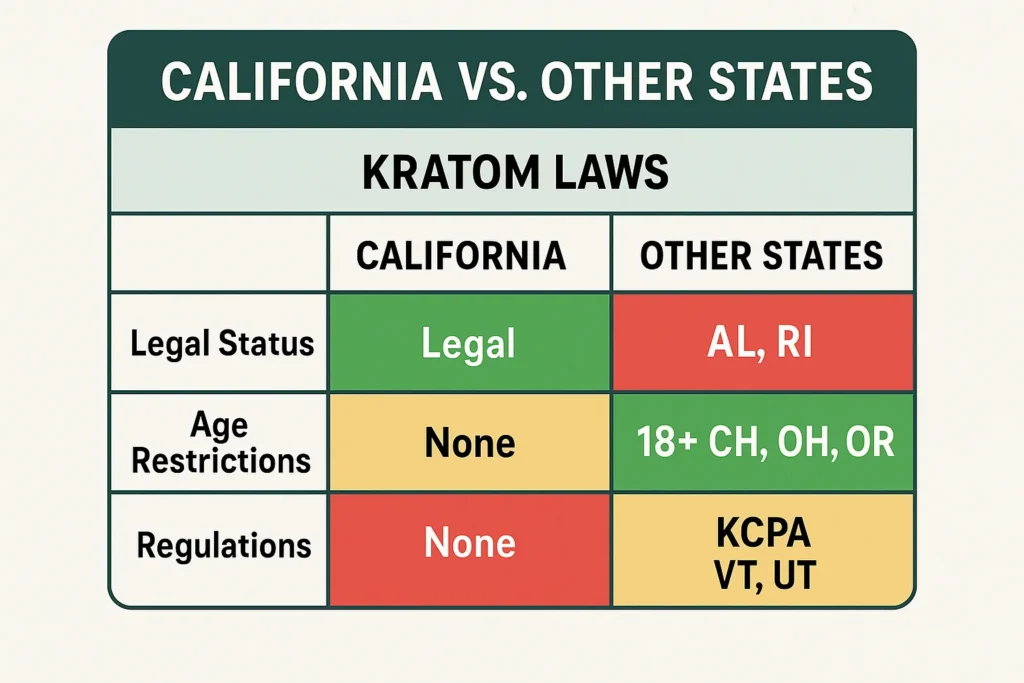
Comparing California to Other States

California’s moderate approach to kratom regulation contrasts sharply with both more restrictive and more permissive states.
States with Kratom Bans
Several states have implemented complete kratom prohibitions:
Alabama: Complete ban since 2016
Arkansas: Banned with criminal penalties
Indiana: Scheduled as controlled substance
Rhode Island: Complete prohibition
Vermont: Banned for all uses
Wisconsin: Scheduled as controlled substance
States with Kratom Consumer Protection Acts
Some states have embraced comprehensive regulation:
Arizona: Age restrictions and quality standards
Georgia: Consumer protection framework
Nevada: Comprehensive regulatory structure
Utah: Age limits and labeling requirements
California’s Middle Path
California’s approach represents a balanced strategy:
Advantages:
- Avoids outright prohibition
- Allows local control
- Focuses on consumer safety
- Maintains market access
Challenges:
- Regulatory uncertainty
- Patchwork of local laws
- Limited quality standards
- Ongoing federal pressure
For comparison with neighboring states, readers can examine kratom laws in Texas to understand regional variations.
Consumer Guide: Navigating Kratom Laws in California
For California consumers, understanding and complying with kratom regulations requires attention to both state and local requirements.
Before Purchasing Kratom
Smart consumers should:
- Research local laws in their specific city and county
- Verify age requirements and have proper identification
- Choose reputable vendors with quality testing
- Understand possession limits where they exist
Safe Use Practices
California kratom users should follow these guidelines:
Start with Quality Products:
- Purchase from vendors with third-party testing
- Review lab reports for contaminants
- Avoid products with unrealistic claims
Follow Dosage Guidelines:
- Start with small amounts
- Monitor personal response
- Avoid combining with other substances
Stay Informed:
- Monitor local law changes
- Report adverse events to health authorities
- Engage with advocacy organizations
Understanding Your Rights
California kratom consumers have certain protections:
- Due process in enforcement actions
- Appeal rights for regulatory decisions
- Consumer protection under general commerce laws
Resources for Consumers
Valuable resources include:
- American Kratom Association: Advocacy and education
- Local health departments: Current regulations and advisories
- Legal aid organizations: Assistance with regulatory issues
Those interested in learning more about kratom preparation and use can explore guides on how to make kratom tea for optimal consumption practices.
Health and Safety Considerations
While kratom remains legal in most of California, users should understand potential health implications and safety considerations.
Potential Benefits
Research suggests kratom may offer certain benefits:
Pain Management:
- Alternative to prescription opioids
- Chronic pain relief
- Reduced inflammation
Mood Support:
- Anxiety reduction
- Depression symptom management
- Stress relief
Energy Enhancement:
- Natural stimulant effects
- Improved focus
- Enhanced productivity
Potential Risks
Users should also be aware of possible adverse effects:
Physical Side Effects:
- Nausea and vomiting
- Constipation
- Dizziness
- Drowsiness
Dependency Concerns:
- Potential for tolerance development
- Withdrawal symptoms with regular use
- Psychological dependence
Drug Interactions:
- Possible interactions with medications
- Enhanced sedative effects
- Altered metabolism of other drugs
Safe Use Recommendations
Health experts recommend:
- Consult healthcare providers before using kratom
- Start with low doses to assess tolerance
- Avoid daily use to prevent dependency
- Monitor for adverse effects and discontinue if necessary
For those seeking information about discontinuing kratom use, our guide on how to get off kratom provides valuable assistance.
Popular Kratom Strains in California
California’s diverse kratom market offers consumers access to various strains with different effects and characteristics.
Most Popular Varieties
California consumers commonly choose these strains:
Red Vein Strains:
- Red Borneo: Relaxing and pain-relieving
- Red Maeng Da: Potent and long-lasting
- Red Bali: Mild and beginner-friendly
Green Vein Strains:
- Green Borneo: Balanced energy and relaxation
- Green Malay: Long-duration effects
- Green Thai: Energizing and mood-lifting
White Vein Strains:
- White Maeng Da: High energy and focus
- White Borneo: Clean stimulation
- White Thai: Cognitive enhancement
Strain Selection Factors
California consumers consider various factors when choosing strains:
- Desired effects (energy, relaxation, pain relief)
- Time of day for consumption
- Personal tolerance levels
- Quality and testing standards
Regional Preferences
Different areas of California show varying strain preferences:
- Northern California: Higher demand for energizing strains
- Southern California: Preference for relaxing varieties
- Central Valley: Balanced approach to strain selection
How Consumers Can Help
California kratom users can support advocacy efforts by:
- Joining advocacy organizations and staying informed
- Contacting elected officials about kratom issues
- Sharing personal experiences responsibly
- Supporting quality vendors that follow best practices
For more information about kratom advocacy and community resources, visit our main blog for ongoing updates and educational content.
Kratom Legal FAQ – California
Conclusion
Kratom’s legal status in California reflects the state’s pragmatic approach to emerging substances – neither rushing to ban nor fully embracing without oversight. While kratom remains legal at the state level, the complex patchwork of local regulations requires consumers and businesses to stay informed about their specific jurisdictions.
The key facts California residents should remember include:
- State-level legality continues despite multiple ban attempts
- Local restrictions vary significantly across cities and counties
- Age requirements commonly range from 18 to 21 years old
- Quality standards remain largely voluntary but increasingly important
- Federal oversight continues to influence state and local policies
Next Steps for California Kratom Users
To navigate California’s kratom landscape successfully:
- Stay informed about local ordinances in your area
- Choose quality vendors with proper testing and transparency
- Use responsibly and monitor for any adverse effects
- Engage with advocacy efforts to protect consumer access
- Support reasonable regulation that prioritizes safety over prohibition
The future of kratom in California likely involves increased regulation rather than prohibition, with emphasis on consumer protection, quality standards, and public health monitoring. By staying informed and engaged, California’s kratom community can help shape policies that balance access with safety.
Daniel Brooks
Daniel Brooks is a U.S. based botanical writer with over six years of hands on experience in kratom focused content. He studies kratom strains, sourcing standards, dosage patterns, and consumer safety topics. He stays up to date with current news, regulatory changes, and market trends related to kratom and botanical products.
His work includes educational guides, strain breakdowns, and vendor reviews written for everyday users. He avoids promotional language and presents clear facts. Daniel helps readers understand both benefits and risks so they can make informed choices about responsible kratom use.