
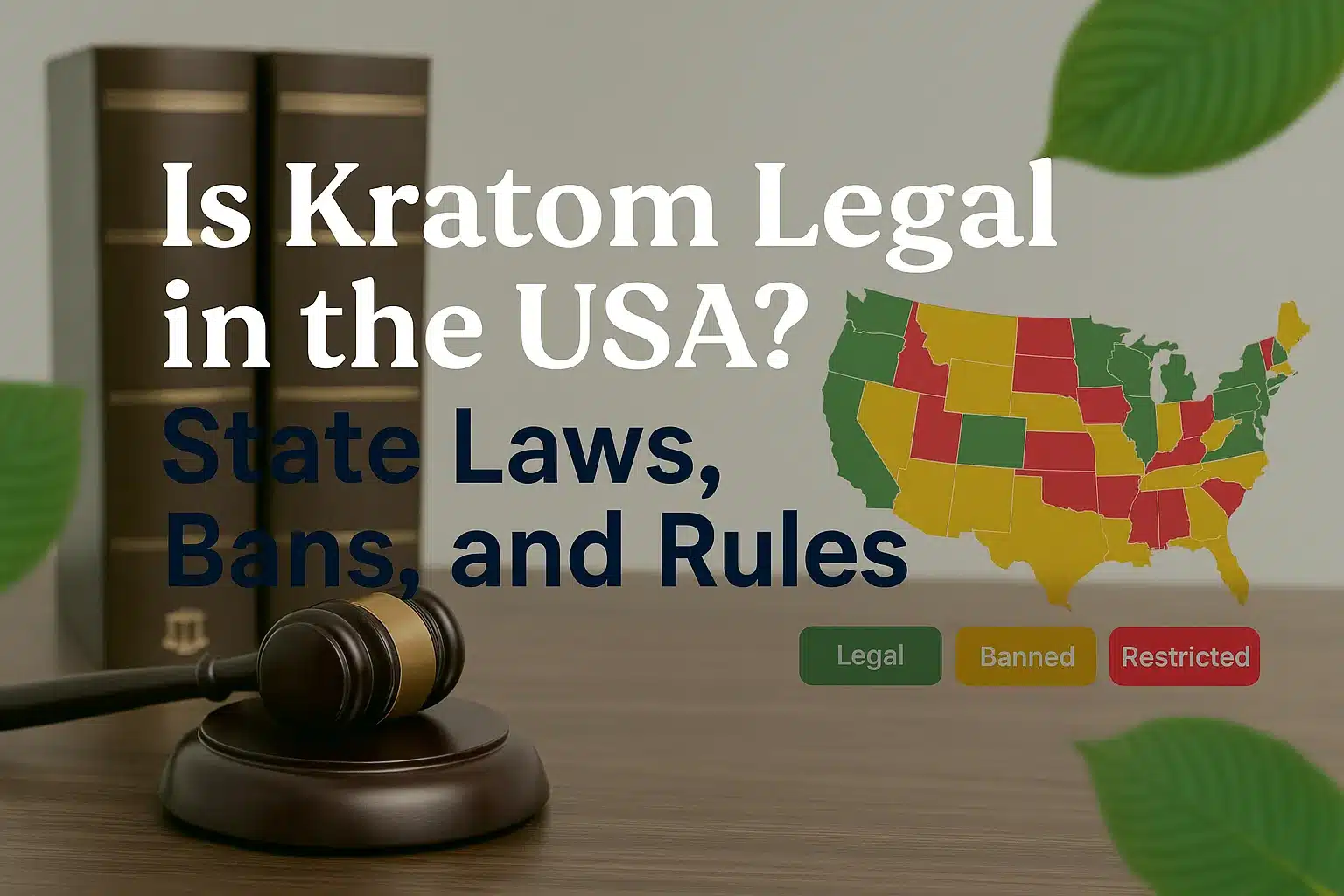
The legal landscape surrounding kratom in America resembles a complex patchwork quilt—with each state thread woven differently into the fabric of federal oversight. While millions of Americans use kratom daily for various wellness purposes, the question “is kratom legal” doesn’t have a simple yes or no answer that applies nationwide.
Understanding kratom’s legal status requires navigating a maze of federal guidelines, state-specific legislation, and local ordinances that can change rapidly. From complete prohibition in certain states to regulated access in others, the current legal framework creates confusion for consumers, vendors, and law enforcement alike.
- Federal Status: Kratom remains federally unscheduled, but the DEA and FDA continue monitoring and expressing concerns about its use
- State Variations: Six states currently ban kratom completely, while others have age restrictions or specific regulations
- Local Laws Matter: Cities and counties can impose their own kratom restrictions even in states where it’s legal
- Regulatory Trends: More states are moving toward regulation rather than outright bans, implementing quality control and age verification requirements
- Legal Changes: Kratom laws evolve frequently, making it essential to stay updated on current regulations in your area
Federal Kratom Legal Status: What You Need to Know
At the federal level, kratom remains unscheduled under the Controlled Substances Act. This means the Drug Enforcement Administration (DEA) hasn’t classified kratom as a controlled substance, allowing it to exist in a legal gray area that individual states can regulate independently.
However, this doesn’t mean kratom operates without federal oversight. The Food and Drug Administration (FDA) has consistently expressed concerns about kratom’s safety profile and has taken several regulatory actions:
FDA’s Position on Kratom
The FDA maintains that kratom poses significant health risks and has:
- Issued warning letters to kratom vendors making unsubstantiated health claims
- Seized kratom shipments containing harmful contaminants
- Prohibited the import of certain kratom products
- Warned against kratom use for opioid withdrawal or pain management
DEA’s Historical Actions
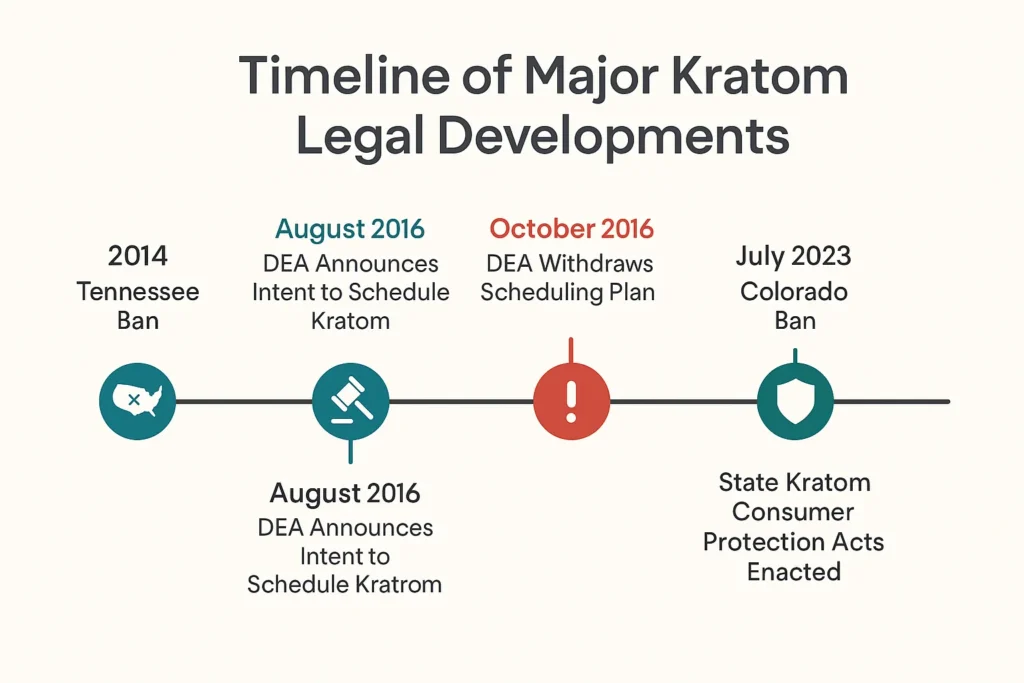
In 2016, the DEA announced plans to emergency schedule kratom as a Schedule I substance but withdrew the proposal following massive public opposition. This withdrawal doesn’t guarantee future protection—the DEA retains the authority to revisit scheduling decisions.
The agency continues monitoring kratom-related incidents and maintains that kratom has “no currently accepted medical use” and possesses “a high potential for abuse.”
Complete State-by-State Kratom Legal Guide
Understanding where kratom is legal requires examining each state’s specific legislation. The legal landscape varies dramatically across state lines, creating a complex web of regulations that consumers must navigate carefully.
States Where Kratom Is Completely Illegal
Six states have implemented complete kratom bans, making possession, sale, and distribution illegal:
| State | Ban Year | Penalties |
|---|---|---|
| Alabama | 2016 | Felony charges possible |
| Arkansas | 2016 | Misdemeanor to felony |
| Indiana | 2014 | Class A misdemeanor |
| Rhode Island | 2017 | Criminal penalties vary |
| Vermont | 2016 | Civil and criminal penalties |
| Wisconsin | 2014 | Controlled substance violations |
States with Age Restrictions and Regulations
Many states allow kratom use but impose specific restrictions:
Age-Restricted States (21+):
- Illinois
- New Hampshire
- Utah
Age-Restricted States (18+):
- California (some counties)
- Florida (some counties)
- Colorado (some counties)
States with Kratom Consumer Protection Acts
Several states have passed Kratom Consumer Protection Acts (KCPA), which regulate rather than ban kratom:
- Arizona: Requires labeling, testing, and age verification
- Georgia: Implements quality standards and retail regulations
- Nevada: Establishes manufacturing and labeling requirements
- Utah: Comprehensive regulation including testing protocols
These acts typically include:
- ✅ Mandatory product testing for contaminants
- ✅ Proper labeling requirements
- ✅ Age verification (usually 18+)
- ✅ Vendor licensing requirements
- ✅ Quality control standards
Local Laws and City-Specific Kratom Regulations
Even in states where kratom remains legal, local municipalities can impose their own restrictions. This creates additional complexity for consumers and vendors operating across different jurisdictions.
Cities with Kratom Bans
Notable cities that have banned kratom include:
- San Diego, California: Complete prohibition since 2016
- Denver, Colorado: Banned in 2017 (later overturned)
- Jerseyville, Illinois: Local ordinance prohibition
- Several Florida counties: Including Sarasota and Union counties
Understanding Local Ordinances
Local kratom laws often focus on:
- Zoning restrictions for kratom retailers
- Business licensing requirements for vendors
- Public consumption prohibitions
- Marketing and advertising limitations
Before purchasing or using kratom, consumers should research both state and local regulations in their area. What’s legal at the state level might be prohibited locally.
Recent Legal Changes and Trends in Kratom Regulation
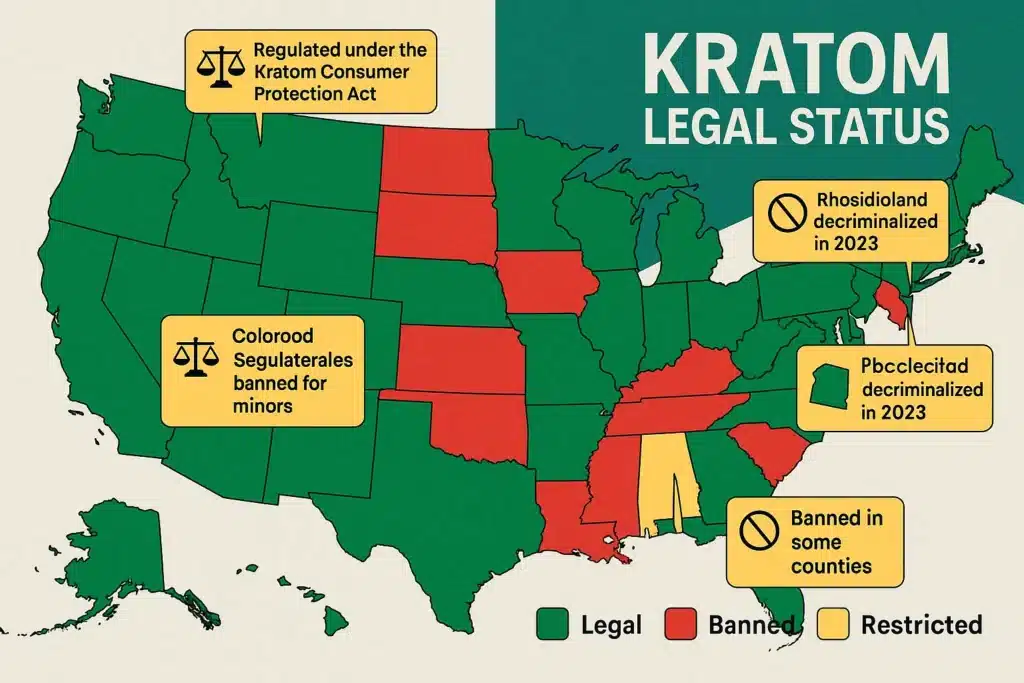
The kratom legal landscape continues evolving rapidly, with significant developments shaping future regulations across the United States.
2023-2024 Legislative Activity
Recent legislative trends show a shift toward regulation rather than prohibition:
New Regulations Passed:
- Montana implemented age restrictions
- Oklahoma passed consumer protection measures
- Several states introduced KCPA legislation
Failed Prohibition Attempts:
- Multiple states rejected ban proposals
- Industry advocacy successfully opposed restrictive measures
- Public testimony influenced legislative decisions
Emerging Regulatory Patterns
Modern kratom legislation increasingly focuses on:
- Quality Control: Mandatory testing for heavy metals, pathogens, and adulterants
- Consumer Safety: Clear labeling requirements and dosage guidelines
- Age Verification: Preventing sales to minors through ID checks
- Vendor Accountability: Licensing requirements and compliance monitoring
These trends suggest lawmakers are moving away from outright bans toward comprehensive regulatory frameworks that balance public safety with consumer access.
For those interested in learning more about kratom’s effects and duration, our comprehensive guide on how long kratom effects last provides valuable insights for responsible use.
Understanding Kratom Scheduling Attempts
The question “is kratom legal” becomes more complex when examining ongoing scheduling attempts at various government levels.
Federal Scheduling Considerations
The DEA evaluates substances for controlled substance scheduling based on eight factors:
- Actual or relative potential for abuse
- Scientific evidence of pharmacological effects
- Current scientific knowledge
- History and current pattern of abuse
- Scope, duration, and significance of abuse
- Risk to public health
- Psychological or physiological dependence liability
- Whether the substance is an immediate precursor
State-Level Scheduling Attempts
Multiple states continue considering kratom scheduling:
- Texas: Regular legislative sessions include kratom discussions
- New York: Ongoing debates about statewide regulation
- Pennsylvania: Periodic scheduling proposals emerge
- Michigan: Local municipalities continue regulatory discussions
Industry Response to Scheduling Threats
The kratom industry has developed sophisticated advocacy strategies:
- Scientific research funding to support safety claims
- Grassroots lobbying efforts engaging consumers
- Professional associations promoting industry standards
- Legal challenges to restrictive legislation
Kratom Vendor Compliance and Legal Requirements
For businesses operating in the kratom space, understanding compliance requirements is crucial for legal operation.
Federal Compliance Requirements
Even without specific kratom scheduling, vendors must navigate:
FDA Regulations:
- No health claims without approval
- Proper supplement labeling requirements
- Good Manufacturing Practice (GMP) compliance
- Adverse event reporting obligations
FTC Requirements:
- Truth in advertising standards
- Substantiation for marketing claims
- Clear disclosure requirements
- Consumer protection compliance
State-Specific Vendor Requirements
States with kratom regulations impose varying vendor obligations:
Licensing Requirements:
- Business registration and permits
- Specialized kratom vendor licenses
- Regular renewal processes
- Compliance monitoring and inspections
Quality Control Standards:
- Third-party testing requirements
- Certificate of analysis documentation
- Contamination screening protocols
- Batch tracking and record keeping
Marketing Restrictions:
- Prohibited health claims
- Age verification in advertising
- Location-based marketing limitations
- Social media compliance requirements
Reputable vendors like those featured in our kratom vendor reviews demonstrate commitment to compliance and quality standards.
🗺️ Kratom Legal Status Checker
Check the current legal status of kratom in your state
Legal Details:
- Age restriction: 18+ years
- Quality testing required
- Vendor licensing mandatory
Impact of Kratom Advocacy on Legal Status
The kratom community’s advocacy efforts have significantly influenced legislative outcomes across the United States. Understanding these efforts provides insight into how kratom legal status continues evolving.
Major Advocacy Organizations
Several organizations lead kratom advocacy efforts:
American Kratom Association (AKA):
- Coordinates legislative advocacy campaigns
- Funds scientific research initiatives
- Provides legal resources for consumers
- Organizes grassroots lobbying efforts
Botanical Education Alliance:
- Focuses on educational outreach
- Supports industry standardization
- Promotes research initiatives
- Advocates for reasonable regulation
Successful Advocacy Outcomes
Kratom advocacy has achieved notable victories:
- DEA Scheduling Reversal (2016): Massive public opposition forced withdrawal
- State Ban Reversals: Several states reconsidered prohibition measures
- KCPA Passage: Multiple states adopted regulatory frameworks
- Research Funding: Increased scientific study support
Consumer Advocacy Strategies
Individual consumers can support kratom advocacy through:
- Legislative Contact: Reaching out to representatives about kratom issues
- Public Comment: Participating in regulatory comment periods
- Education: Sharing accurate information about kratom
- Community Engagement: Supporting local advocacy efforts
For those interested in exploring different kratom varieties, our guides on red indo kratom and white indo kratom provide comprehensive information about popular strains.
International Kratom Legal Perspectives

Understanding global kratom regulations provides context for domestic legal discussions and helps predict future trends in American kratom law.
International Kratom Status
Countries Where Kratom Is Legal:
- Canada (regulated as natural health product)
- Mexico (no specific restrictions)
- Most European Union countries
- Several South American nations
Countries with Kratom Restrictions:
- Thailand (recently legalized after decades-long ban)
- Malaysia (scheduled as controlled substance)
- Australia (prescription-only medicine)
- United Kingdom (psychoactive substances ban)
Lessons from International Regulation
International experiences offer valuable insights:
Thailand’s Reversal: After decades of prohibition, Thailand legalized kratom in 2021, recognizing traditional use and economic benefits.
Canada’s Approach: Regulated as natural health products with specific quality and labeling requirements.
European Variations: Different EU countries maintain varying approaches, from complete freedom to specific restrictions.
Potential Federal Developments
Federal kratom regulation could evolve through several pathways:
Congressional Action: Legislation specifically addressing kratom’s federal status could provide nationwide clarity.
FDA Regulatory Framework: The agency might develop comprehensive kratom regulations similar to dietary supplement oversight.
DEA Scheduling Decisions: Future scheduling attempts remain possible, though recent advocacy success suggests strong opposition.
State-Level Predictions
State kratom laws will likely continue diversifying:
- More KCPA Adoption: Additional states may pass consumer protection acts
- Uniform Standards: Interstate commerce may drive standardization
- Local Preemption: State laws might override local prohibition efforts
- Age Harmonization: Consistent age requirements across states
For those seeking quality kratom products from reputable sources, exploring reviews of vendors like Arena Ethnobotanicals can help identify compliant suppliers.
Kratom Legal Resources and Staying Informed
Staying current with kratom legal developments requires reliable information sources and regular monitoring of legislative changes.
Official Government Resources
Federal Agencies:
- DEA: Controlled substance scheduling updates
- FDA: Safety warnings and regulatory actions
- NIDA: Research findings and policy positions
- Congress: Federal legislation tracking
State Resources:
- State legislature websites for bill tracking
- Attorney general offices for enforcement updates
- Department of health advisories
- Professional licensing board guidance
Industry and Advocacy Resources
American Kratom Association: Provides legislative updates, advocacy tools, and legal resources for consumers and vendors.
Kratom Trade Association: Offers industry news, compliance guidance, and regulatory analysis.
Academic Research: Universities conducting kratom studies publish findings that influence policy decisions.
Legal Consultation
Complex kratom legal questions may require professional guidance:
- Criminal Defense: For possession or distribution charges
- Business Law: For vendor compliance and licensing
- Regulatory Compliance: For manufacturing and distribution
- Advocacy Strategy: For legislative engagement efforts
Consumer Rights and Legal Protections
Understanding consumer rights within current kratom legal frameworks helps users navigate complex regulatory environments.
Consumer Protection Rights
In states with kratom regulation, consumers typically have rights to:
Product Quality: Access to tested, uncontaminated kratom products meeting established standards.
Accurate Information: Proper labeling including ingredients, origins, and safety warnings.
Age Verification: Protection of minors through mandatory age checking systems.
Complaint Resolution: Mechanisms for reporting unsafe products or vendor violations.
Legal Recourse Options
Consumers facing kratom-related legal issues have several options:
Product Liability: Claims against vendors selling contaminated or mislabeled products.
Consumer Protection: State attorney general enforcement of consumer protection laws.
Civil Rights: Challenges to discriminatory enforcement of kratom regulations.
Due Process: Constitutional protections in criminal kratom cases.
Safe Consumption Practices
Legal kratom use includes responsibility for safe consumption:
- Dosage Awareness: Understanding appropriate serving sizes
- Quality Verification: Choosing vendors with testing protocols
- Legal Compliance: Following all applicable state and local laws
- Medical Consultation: Discussing kratom use with healthcare providers
Information about yellow indo kratom and other varieties can help consumers make informed choices about different kratom types.
Kratom Business Legal Considerations
For entrepreneurs considering kratom business ventures, understanding the complex legal landscape is essential for compliance and success.
Business Structure Considerations
Entity Selection: Choosing appropriate business structures that accommodate kratom industry banking and regulatory challenges.
Location Strategy: Selecting business locations in kratom-friendly jurisdictions with supportive regulatory frameworks.
Insurance Coverage: Securing appropriate liability coverage for kratom-related business activities.
Regulatory Compliance Framework
Quality Control Systems: Implementing testing protocols, batch tracking, and contamination prevention measures.
Marketing Compliance: Avoiding prohibited health claims while effectively communicating product benefits.
Record Keeping: Maintaining detailed documentation for regulatory compliance and audit purposes.
Employee Training: Ensuring staff understand legal requirements and compliance obligations.
Financial and Banking Challenges
The kratom industry faces unique financial challenges:
- Banking Restrictions: Many financial institutions avoid kratom businesses
- Payment Processing: Credit card companies may restrict kratom transactions
- Insurance Limitations: Specialized coverage requirements for kratom operations
- Tax Compliance: Complex tax obligations for kratom businesses
Medical and Legal Intersection
The relationship between kratom’s medical applications and legal status creates complex considerations for consumers, healthcare providers, and policymakers.
Healthcare Provider Perspectives
Medical professionals navigate kratom’s legal ambiguity when patients report use:
Clinical Considerations: Evaluating potential interactions, benefits, and risks in patient care.
Legal Liability: Understanding professional obligations when patients use unregulated substances.
Documentation Requirements: Proper medical record keeping regarding kratom use discussions.
Patient Education: Providing accurate information about legal status and safety considerations.
Medical Research Implications
Scientific research on kratom faces regulatory challenges:
Research Restrictions: Federal oversight complicates clinical trial approval processes.
Funding Limitations: Limited federal research funding affects study scope and quality.
Publication Standards: Academic journals require rigorous methodology for kratom studies.
Regulatory Impact: Research findings influence future policy decisions and legal status.
Patient Rights and Medical Use
Patients using kratom for medical purposes have specific considerations:
- Disclosure Obligations: Informing healthcare providers about kratom use
- Drug Testing: Understanding workplace and medical drug testing implications
- Insurance Coverage: Kratom typically isn’t covered by health insurance
- Legal Protections: Limited legal protections for medical kratom use
Those interested in learning about kratom’s potential benefits might explore information about brown indo kratom and its reported effects.
Frequently Asked Questions About Kratom Legality
Yes, kratom is currently legal at the federal level in the United States. The DEA has not scheduled kratom as a controlled substance, though they have considered doing so in the past. However, federal legality doesn’t guarantee state or local legality.
As of 2024, the following states have completely banned kratom: Alabama, Arkansas, Indiana, Rhode Island, Vermont, and Wisconsin. Additionally, several counties and cities in other states have local bans.
The KCPA is model legislation that regulates kratom rather than banning it outright. It sets age restrictions (21+), requires labeling, prohibits adulterated products, and establishes testing standards. States like Nevada, Utah, Georgia, and others have adopted versions of this act.
Traveling with kratom can be risky. Even if it’s legal in your departure and destination states, you might pass through states where it’s banned. Some states have laws against possession even when just passing through. Research all states on your route before traveling.
Age restrictions vary by state. In states with KCPA legislation, the minimum age is typically 21. Some states set the age at 18, while others have no specific age restrictions. Many reputable vendors voluntarily require customers to be 18 or 21 regardless of local laws.
Yes, it’s possible. The DEA has previously attempted to schedule kratom and could do so again. The FDA has also expressed concerns about kratom. However, advocacy groups and scientific research supporting kratom’s benefits continue to influence policy decisions.
Always research current laws before purchasing or possessing kratom. Check your state laws, county ordinances, and city regulations. Contact local law enforcement or a legal professional if you’re uncertain. When in doubt, err on the side of caution.
Enforcement and Criminal Justice Aspects
Understanding how kratom laws are enforced helps consumers and businesses navigate legal risks and compliance requirements.
Law Enforcement Training
Police departments in kratom-legal states need specific training:
Identification Protocols: Teaching officers to distinguish kratom from illegal substances.
Testing Procedures: Proper field testing and laboratory confirmation methods.
Legal Standards: Understanding state-specific kratom regulations and enforcement authority.
Evidence Handling: Proper procedures for kratom-related investigations and prosecutions.
Criminal Defense Considerations
Kratom-related criminal cases involve unique legal issues:
Jurisdictional Questions: Determining which laws apply in multi-state cases.
Product Testing: Challenging laboratory analysis and contamination claims.
Intent Elements: Proving knowledge of legal status and regulatory compliance.
Constitutional Issues: Challenging vague or overly broad kratom prohibitions.
Prosecutorial Discretion
District attorneys exercise discretion in kratom cases:
- Resource Allocation: Prioritizing serious crimes over minor kratom violations
- Public Interest: Considering community impact of kratom prosecutions
- Legal Clarity: Avoiding prosecution when laws are unclear or changing
- Diversion Programs: Offering treatment alternatives for kratom-related charges
Economic Impact of Kratom Legality
The legal status of kratom significantly affects economic activity, employment, and tax revenue across different states.
Industry Economic Contributions
Legal kratom markets generate substantial economic activity:
Direct Employment: Retailers, manufacturers, distributors, and testing laboratories create jobs in kratom-legal states.
Tax Revenue: Sales taxes, business licenses, and regulatory fees contribute to state and local budgets.
Ancillary Services: Legal, accounting, marketing, and consulting services support kratom businesses.
Agricultural Impact: Domestic kratom cultivation experiments create potential agricultural opportunities.
Economic Costs of Prohibition
States banning kratom face different economic implications:
Enforcement Costs: Police, courts, and corrections expenses for kratom-related violations.
Lost Revenue: Foregone tax revenue from prohibited kratom sales.
Cross-Border Commerce: Residents purchasing kratom in neighboring legal states.
Black Market Activity: Unregulated sales continuing despite prohibition efforts.
Regional Economic Variations
Different regions experience varying economic impacts:
- Urban Markets: Cities with kratom shops see increased foot traffic and business activity
- Rural Areas: Limited access to kratom businesses affects local economic development
- Border States: Proximity to different legal jurisdictions affects commerce patterns
- Tourism Impact: Kratom legality may influence visitor spending and business travel
For comprehensive information about the kratom industry and market trends, readers can explore our kratom blog for regular updates and insights.
Technology and Kratom Legal Compliance
Modern technology plays an increasingly important role in kratom legal compliance, from age verification to product tracking and quality assurance.
Digital Age Verification
Online kratom vendors must implement robust age verification:
Identity Verification: Third-party services confirm customer ages before sales.
Document Authentication: Advanced systems verify government-issued identification.
Geographic Restrictions: Technology blocks sales to prohibited jurisdictions.
Compliance Monitoring: Automated systems track and report verification activities.
Blockchain and Product Tracking
Emerging technologies enhance kratom supply chain transparency:
Batch Tracking: Blockchain systems create immutable records of product origins and testing.
Quality Assurance: Digital certificates of analysis provide verifiable product information.
Regulatory Reporting: Automated compliance reporting to regulatory authorities.
Consumer Transparency: QR codes allow customers to verify product authenticity and testing.
E-commerce Legal Challenges
Online kratom sales face unique legal considerations:
- Multi-state Compliance: Navigating different state laws for interstate commerce
- Payment Processing: Credit card restrictions affecting online transactions
- Shipping Restrictions: Carrier policies prohibiting kratom delivery
- Advertising Limitations: Platform restrictions on kratom marketing content
International Trade and Kratom Legality
Global kratom trade intersects with domestic legal considerations, affecting imports, exports, and international business relationships.
Import Regulations
Kratom imports face federal oversight regardless of state legality:
FDA Import Alerts: Automatic detention of certain kratom shipments at borders.
Customs Enforcement: Border agents inspect kratom shipments for compliance violations.
Documentation Requirements: Importers must provide detailed product information and testing results.
Quality Standards: International shipments must meet domestic quality and safety requirements.
Export Considerations
American kratom businesses face international export challenges:
Destination Legality: Ensuring kratom legality in receiving countries.
Documentation Compliance: Meeting international shipping and customs requirements.
Quality Certifications: Providing testing and quality documentation for exports.
Banking Restrictions: International payment processing challenges for kratom businesses.
Trade Policy Implications
International trade policies affect domestic kratom markets:
- Tariff Considerations: Import duties on kratom affecting domestic pricing
- Trade Agreements: International agreements potentially affecting kratom commerce
- Diplomatic Relations: Foreign policy considerations influencing kratom trade
- Supply Chain Security: International security measures affecting kratom imports
Vendors like Artisan Botanicals navigate these complex international trade requirements while maintaining product quality and legal compliance.
Conclusion
The question “is kratom legal” reveals a complex tapestry of federal guidelines, state regulations, and local ordinances that continue evolving across the United States. While kratom remains federally unscheduled, the legal landscape varies dramatically from complete prohibition in six states to comprehensive regulatory frameworks in others.
Current trends suggest a movement toward regulation rather than outright prohibition, with more states adopting Kratom Consumer Protection Acts that prioritize quality control and consumer safety over blanket bans. This regulatory approach acknowledges kratom’s widespread use while addressing legitimate safety concerns through testing requirements, age restrictions, and vendor licensing.
For consumers, staying informed about local laws remains crucial. The legal status can change rapidly at state and local levels, making regular monitoring of legislative developments essential. Those living in kratom-legal jurisdictions should prioritize purchasing from reputable vendors who comply with applicable regulations and maintain rigorous quality standards.