The legal landscape surrounding kratom continues to evolve across the United States, leaving many Oklahoma residents wondering about their rights and the current status of this controversial botanical substance. While some states have enacted complete bans, others have embraced regulation, creating a patchwork of laws that can be confusing to navigate.
Oklahoma’s approach to kratom regulation reflects a growing trend toward balanced legislation that prioritizes consumer safety while preserving access to this traditional herbal supplement. Understanding these laws isn’t just important for current users—it’s essential for anyone considering kratom as an alternative wellness option.
- Kratom is legal in Oklahoma for adults 18 and older, with specific regulations in place
- The state follows the Kratom Consumer Protection Act (KCPA) framework for regulation
- Age restrictions apply—you must be 18+ to purchase, possess, or consume kratom
- Quality standards are enforced, including testing requirements and labeling standards
- Local municipalities may have additional restrictions beyond state law
- Purchasing from reputable vendors ensures compliance with Oklahoma’s safety regulations
Current Legal Status: Is Kratom Legal In Oklahoma?
Yes, kratom is legal in Oklahoma as of the current date. The Sooner State has taken a progressive approach to kratom regulation, choosing to implement consumer protection measures rather than outright prohibition. This decision aligns Oklahoma with a growing number of states that recognize kratom’s potential benefits while acknowledging the need for proper oversight.
Oklahoma’s legal framework for kratom centers around the Kratom Consumer Protection Act (KCPA), which was signed into law in 2021. This legislation represents a balanced approach that aims to:
- Ensure product safety and quality
- Prevent access by minors
- Establish clear labeling requirements
- Create accountability for vendors and manufacturers
The state’s decision to regulate rather than ban kratom reflects input from various stakeholders, including kratom advocates, public health officials, and law enforcement agencies. This collaborative approach has resulted in legislation that protects consumers while maintaining legal access to kratom products.
What Makes Oklahoma’s Approach Unique
Oklahoma’s kratom laws stand out for several reasons:
🔍 Comprehensive Testing Requirements: Products must be tested for contaminants and adulterants
📋 Clear Labeling Standards: All products must include specific information about contents and warnings
👥 Age Verification: Strict enforcement of 18+ age requirements
⚖️ Vendor Accountability: Sellers must comply with specific licensing and operational standards
Understanding the Kratom Consumer Protection Act in Oklahoma
The Kratom Consumer Protection Act (KCPA) serves as the foundation for kratom regulation in Oklahoma. This comprehensive legislation addresses multiple aspects of kratom commerce and consumption, creating a framework that prioritizes public safety while preserving access for adult consumers.
Key Provisions of Oklahoma’s KCPA
Age Restrictions and Penalties
The law establishes 18 years as the minimum age for kratom purchase, possession, and consumption. Violations can result in:
- Fines for underage possession
- Penalties for vendors who sell to minors
- Potential license revocation for repeat offenders
Product Testing and Quality Standards
All kratom products sold in Oklahoma must undergo rigorous testing to ensure they are:
- Free from harmful contaminants like heavy metals and pathogens
- Not adulterated with synthetic substances or other drugs
- Properly processed and stored to maintain quality
Labeling and Marketing Requirements
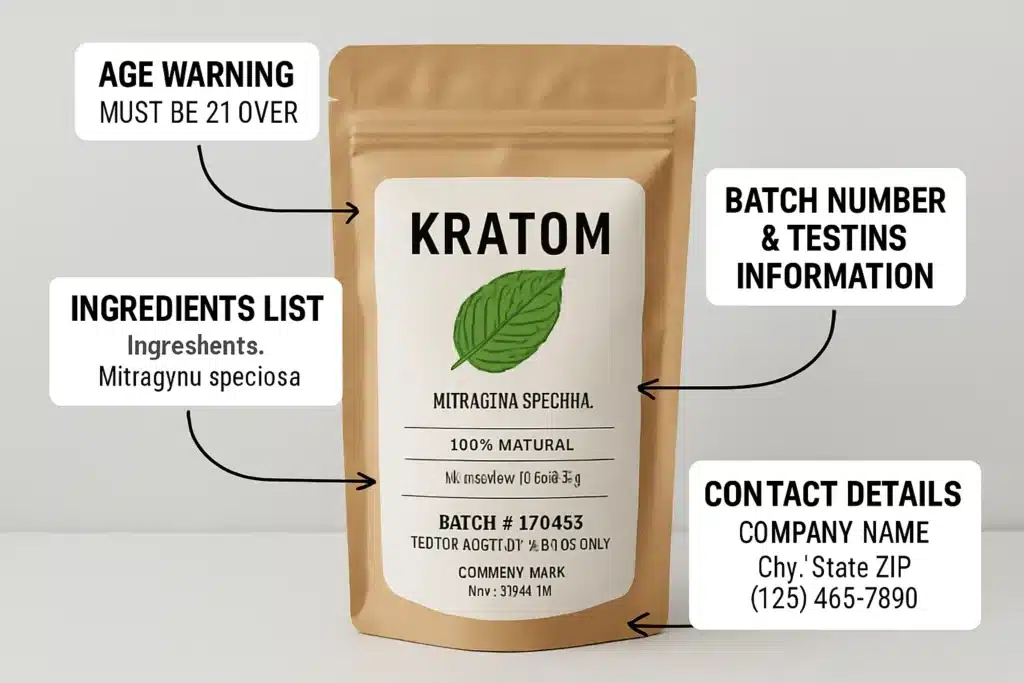
Kratom products must include:
- Clear ingredient lists with accurate kratom content
- Batch numbers for traceability
- Expiration dates to ensure freshness
- Warning labels about potential risks and proper usage
- Contact information for the manufacturer or distributor
Compliance and Enforcement
Oklahoma’s Department of Health oversees kratom regulation enforcement, working with local authorities to ensure compliance. The state has established clear protocols for:
- Routine inspections of retail locations
- Product testing at certified laboratories
- Investigation procedures for reported violations
- Penalty structures for non-compliant vendors
For consumers interested in learning more about kratom purchasing guidelines, understanding these regulations helps ensure you’re buying from compliant vendors.
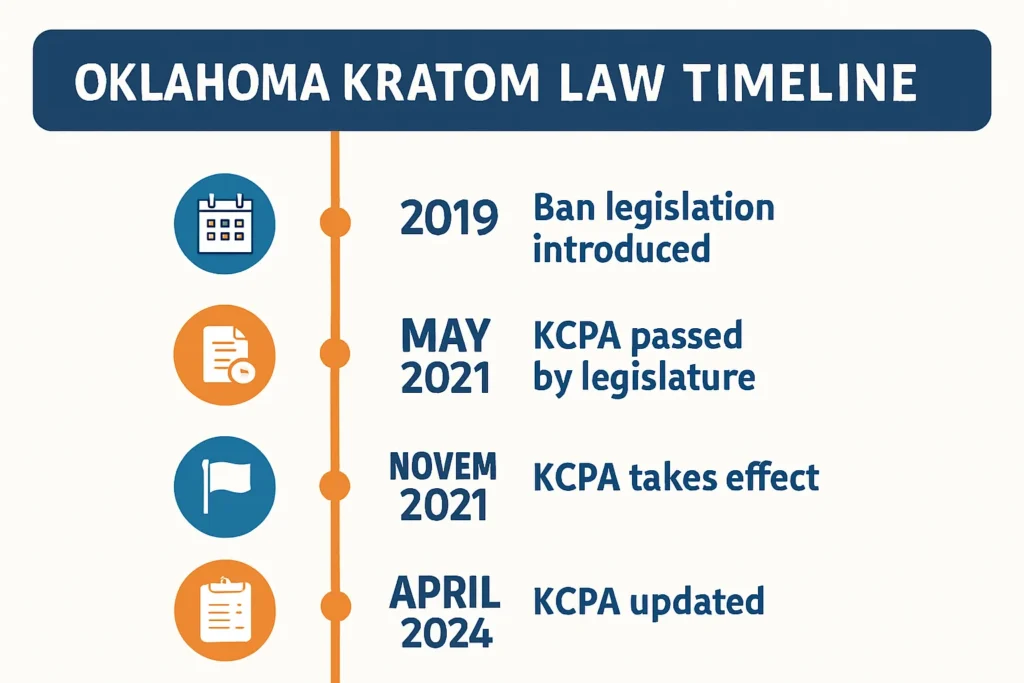
Historical Timeline of Kratom Laws in Oklahoma
Understanding how Oklahoma arrived at its current kratom laws provides valuable context for the regulatory landscape. The state’s journey toward kratom regulation reflects broader national trends and local advocacy efforts.
Pre-2019: Unregulated Status
Before formal legislation, kratom existed in a legal gray area in Oklahoma. While not explicitly banned, the lack of regulation meant:
- No quality standards for products
- Inconsistent availability across the state
- Uncertainty for both consumers and vendors
- Potential for problematic products to enter the market
2019-2020: Legislative Discussions
During this period, Oklahoma lawmakers began seriously considering kratom regulation. Key developments included:
- Public hearings featuring testimony from users, advocates, and health professionals
- Research reviews examining kratom’s safety profile and potential benefits
- Stakeholder meetings bringing together diverse perspectives on regulation
- Draft legislation incorporating input from multiple sources
2021: KCPA Implementation
The passage of Oklahoma’s Kratom Consumer Protection Act marked a significant milestone:
- Bipartisan support demonstrated broad legislative consensus
- Industry collaboration helped shape practical regulatory requirements
- Consumer advocacy ensured access remained protected
- Public health priorities guided safety provisions
Post-2021: Ongoing Refinements
Since implementation, Oklahoma has continued to refine its kratom regulations:
- Enforcement protocols have been developed and tested
- Industry feedback has led to practical adjustments
- Consumer education efforts have expanded
- Monitoring systems track compliance and effectiveness
This evolutionary approach mirrors patterns seen in other states with comprehensive kratom legislation, demonstrating how thoughtful regulation can balance multiple interests.
🏛️ Oklahoma Kratom Law Compliance Checker
Check if your kratom purchase or use complies with Oklahoma state law
Age Requirements and Restrictions
One of the most important aspects of Oklahoma’s kratom legislation involves age restrictions. Understanding these requirements is crucial for both consumers and vendors operating within the state.
Minimum Age Requirement
Oklahoma law establishes 18 years as the minimum age for kratom-related activities. This applies to:
- Purchasing kratom products from any vendor
- Possessing kratom in any form
- Consuming kratom products
- Distributing kratom to others
Enforcement and Penalties
The state takes age restrictions seriously, with specific penalties for violations:
For Minors
- First offense: Warning and confiscation of products
- Subsequent offenses: Fines up to $200
- Potential consequences: Involvement of parents/guardians and possible community service
For Vendors
- Selling to minors: Fines ranging from $500-$2,000 per incident
- Repeat violations: License suspension or revocation
- Criminal charges: Possible in cases of willful or repeated violations
Age Verification Requirements
Vendors must implement robust age verification systems:
🆔 In-Person Sales
- Valid government-issued photo ID required
- ID must be current and not expired
- Vendors must verify the person matches the ID
💻 Online Sales
- Age verification at point of purchase
- Credit card verification (must match adult name)
- Some vendors require additional identity confirmation
Comparison with Other States
Oklahoma’s 18+ requirement aligns with most states that have legalized kratom. However, some states have implemented different age thresholds:
- 21+ states: Some states set the minimum age at 21
- No age restrictions: A few states with kratom legality have no specific age requirements
- Varying local laws: Some municipalities may have stricter age requirements
For those interested in age requirements across different states, our guide on kratom age restrictions provides comprehensive information.
Quality Standards and Testing Requirements
Oklahoma’s commitment to consumer safety is evident in its comprehensive quality standards and testing requirements. These regulations ensure that kratom products sold within the state meet specific safety and purity criteria.
Mandatory Testing Protocols
All kratom products sold in Oklahoma must undergo testing for:
Contaminant Testing
- Heavy metals: Lead, mercury, cadmium, and arsenic
- Microbial contaminants: E. coli, salmonella, and other harmful bacteria
- Pesticide residues: Agricultural chemicals that could pose health risks
- Mycotoxins: Toxic compounds produced by mold and fungi
Adulteration Testing
- Synthetic substances: Artificial compounds not naturally found in kratom
- Pharmaceutical drugs: Prescription or over-the-counter medications
- Other botanical adulterants: Non-kratom plant materials used as fillers
- Chemical additives: Artificial enhancers or preservatives
Laboratory Requirements
Testing must be conducted by state-approved laboratories that meet specific criteria:
✅ Accreditation Standards
- ISO/IEC 17025 certification preferred
- State-recognized testing protocols
- Regular quality assurance audits
- Qualified personnel and equipment
📊 Testing Documentation
- Certificates of analysis (COAs) for each batch
- Detailed testing methodologies
- Chain of custody documentation
- Results must be available to regulators upon request
Product Specifications
Oklahoma law establishes specific requirements for kratom products:
Purity Standards
- Minimum kratom content: Products must contain primarily kratom leaf material
- Maximum moisture content: Limits to prevent mold and degradation
- Particle size consistency: For powdered products
- Color and appearance: Must match expected kratom characteristics
Packaging Requirements
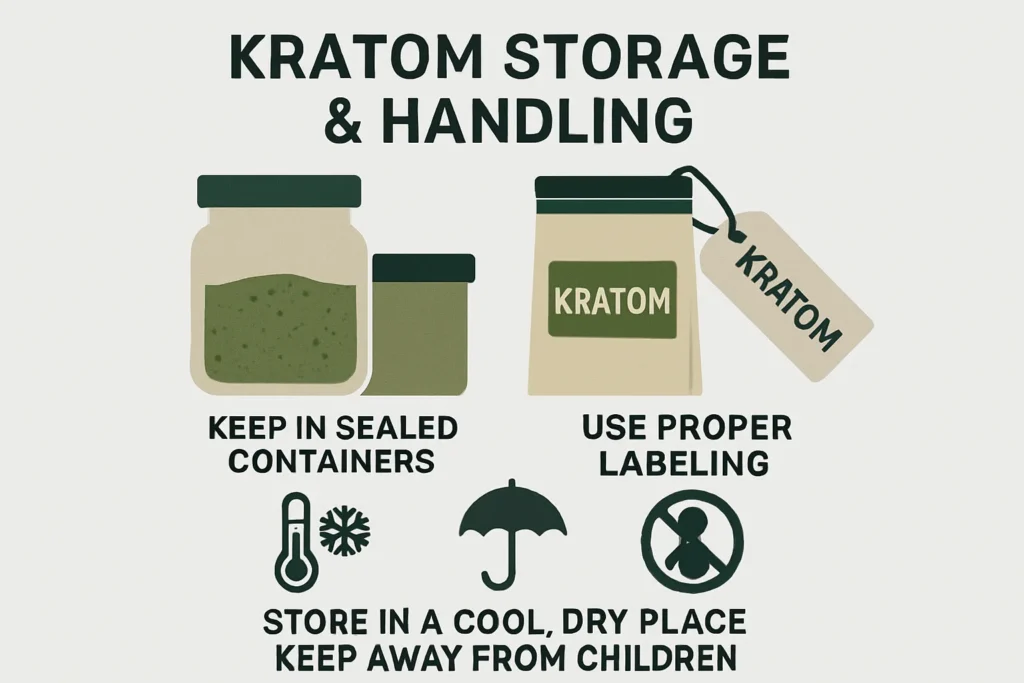
- Sealed containers: Tamper-evident packaging required
- Moisture barriers: Protection against humidity and contamination
- Light protection: UV-resistant packaging for light-sensitive products
- Child-resistant options: Recommended for household safety
Vendor Responsibilities
Kratom vendors in Oklahoma must:
🔍 Maintain Records
- Testing certificates for all products
- Batch tracking from source to sale
- Vendor certifications and licenses
- Customer complaint logs and resolutions
📋 Quality Assurance
- Regular product testing schedules
- Supplier verification and auditing
- Storage and handling protocols
- Employee training on quality standards
When shopping for kratom, consumers should look for vendors who provide transparent testing information. Resources on where to buy kratom safely online can help identify compliant vendors.
Labeling and Marketing Requirements
Oklahoma’s labeling and marketing requirements for kratom products are designed to ensure consumers have access to accurate information while preventing misleading claims. These regulations create transparency in the marketplace and help consumers make informed decisions.
Required Label Information
Every kratom product sold in Oklahoma must include specific information on its packaging:
Basic Product Information
- Product name and kratom strain/variety
- Net weight or quantity of contents
- Batch or lot number for traceability
- Manufacturing date and expiration date
- Ingredients list in descending order by weight
Manufacturer and Distributor Details
- Company name and complete address
- Contact information including phone number
- License numbers where applicable
- Country of origin for the kratom leaf material
Safety Information
- Age restriction warning: “Not for use by minors under 18”
- Pregnancy warning: Advisory against use during pregnancy or nursing
- Interaction warnings: Potential interactions with medications or alcohol
- Dosage guidance: General information about appropriate serving sizes
Prohibited Marketing Claims
Oklahoma law specifically prohibits certain types of marketing claims for kratom products:
❌ Medical Claims
- Cannot claim to diagnose, treat, cure, or prevent any disease
- No references to specific medical conditions
- Prohibition on therapeutic benefit claims
- Cannot suggest FDA approval for medical use
❌ Misleading Statements
- False purity or potency claims
- Unsubstantiated quality assertions
- Misleading origin or source information
- Exaggerated effect descriptions
Approved Marketing Language
Vendors may use certain types of descriptive language:
✅ Acceptable Descriptions
- Strain names and botanical information
- Traditional use references (with disclaimers)
- General quality descriptors (premium, fresh, etc.)
- Processing method descriptions
✅ Educational Content
- Historical and cultural information
- Botanical and scientific facts
- Preparation and consumption methods
- Legal status and compliance information
Digital Marketing Compliance
Online vendors must also comply with specific digital marketing requirements:
Website Requirements
- Age verification before allowing site access
- Clear disclaimers about product claims
- Accurate product descriptions matching physical labels
- Transparent pricing without hidden fees
Social Media Guidelines
- Platform compliance with individual social media policies
- Responsible advertising avoiding prohibited claims
- Age-appropriate targeting for advertising campaigns
- Educational focus rather than promotional emphasis
Enforcement and Penalties
Non-compliance with labeling and marketing requirements can result in:
⚖️ Administrative Actions
- Warning letters for minor violations
- Required corrective actions and timelines
- Product recalls for mislabeled items
- Temporary sales suspensions
⚖️ Financial Penalties
- Fines based on violation severity
- Cost recovery for regulatory investigations
- Required compliance audits at vendor expense
- Bond requirements for repeat offenders
Understanding these requirements helps consumers identify legitimate vendors. For more information about evaluating kratom vendors, check out reviews of compliant companies like Botanical Boulevard.
Local Municipality Laws and Variations
While Oklahoma state law provides the overarching framework for kratom regulation, local municipalities may implement additional restrictions or requirements. Understanding these local variations is crucial for consumers and vendors operating in different parts of the state.
Municipal Authority and Scope
Oklahoma municipalities have limited but important authority regarding kratom regulation:
What Municipalities Can Regulate
- Zoning restrictions for kratom retail locations
- Business licensing requirements beyond state mandates
- Operating hours for kratom retailers
- Signage and advertising restrictions in public areas
- Additional age verification procedures
What Municipalities Cannot Override
- State age requirements (cannot lower below 18)
- Basic legality of kratom possession and use
- State testing standards and quality requirements
- Fundamental KCPA provisions established by state law
Major Cities and Their Kratom Policies
Oklahoma City
Oklahoma City generally follows state regulations without additional restrictions:
- Standard licensing requirements for retailers
- Zoning compliance for commercial kratom sales
- No additional age restrictions beyond state law
- Regular inspections in coordination with state authorities
Tulsa
Tulsa has implemented some additional oversight measures:
- Enhanced retailer licensing with annual renewals
- Specific zoning requirements limiting locations near schools
- Additional signage requirements for age restrictions
- Coordination with health department for compliance monitoring
Norman
Norman follows a moderate approach with some local considerations:
- University proximity restrictions due to the presence of OU
- Student-focused education programs about kratom laws
- Standard business licensing requirements
- Collaboration with campus authorities on enforcement
Broken Arrow
Broken Arrow maintains basic compliance with state law:
- Standard zoning requirements for retail establishments
- No additional restrictions beyond state mandates
- Regular business inspections for compliance
- Community education programs about kratom regulations
Rural Areas and Small Towns
Smaller municipalities across Oklahoma generally follow state law with minimal additional requirements:
🏘️ Common Characteristics
- Limited local enforcement resources
- Reliance on state oversight for compliance
- Basic business licensing requirements
- Community-based education approaches
🏘️ Potential Variations
- Some towns may have stricter zoning requirements
- Limited availability due to lack of retailers
- Varying levels of law enforcement familiarity with kratom laws
- Different approaches to public education
Checking Local Laws
Before purchasing or selling kratom in any Oklahoma municipality, it’s important to:
- Contact local authorities to verify current regulations
- Check city websites for published ordinances
- Consult with local attorneys for complex situations
- Stay updated on changing local policies
Purchasing Kratom Legally in Oklahoma
Understanding how to purchase kratom legally in Oklahoma involves more than just knowing the laws—it requires awareness of best practices, vendor selection, and consumer responsibilities. This section provides practical guidance for legal kratom acquisition.
Choosing Legal Vendors
Licensed Oklahoma Retailers
When purchasing from brick-and-mortar stores in Oklahoma:
🏪 Verification Steps
- Confirm the retailer has proper state licensing
- Check for posted age restriction signage
- Verify products have required labeling
- Ask to see certificates of analysis (COAs)
🏪 What to Look For
- Clean, professional retail environment
- Knowledgeable staff familiar with state laws
- Proper product storage and handling
- Clear pricing without hidden fees
Reputable Online Vendors
Online purchasing offers convenience but requires additional diligence:
💻 Vendor Evaluation Criteria
- Compliance documentation: Clear evidence of KCPA compliance
- Testing transparency: Readily available lab results
- Professional website: Proper age verification and disclaimers
- Customer reviews: Positive feedback about quality and service
💻 Red Flags to Avoid
- Vendors making medical claims
- Lack of proper labeling information
- No available testing documentation
- Suspiciously low prices suggesting poor quality
Legal Purchase Process
Age Verification
Every legal kratom purchase requires proper age verification:
- Government-issued ID: Driver’s license, passport, or state ID
- Current and valid: Expired IDs are not acceptable
- Photo matching: ID must match the purchaser
- Digital verification: Online purchases may require additional verification
Documentation and Records
While not required for consumers, maintaining purchase records can be helpful:
- Receipts: Proof of legal purchase from licensed vendors
- Product information: Batch numbers and testing documentation
- Vendor details: Contact information for quality issues
- Purchase dates: Tracking for personal inventory management
Understanding Pricing and Value
Legal kratom pricing in Oklahoma reflects quality and compliance costs:
Factors Affecting Price
- Testing and quality assurance expenses
- Regulatory compliance costs
- Vendor licensing and operational expenses
- Product quality and sourcing standards
Price Ranges
- Budget options: $8-12 per ounce for basic products
- Mid-range products: $12-18 per ounce for tested products
- Premium offerings: $18-25+ per ounce for specialty strains
For detailed information about kratom pricing factors, our guide on how much kratom costs provides comprehensive pricing analysis.
Consumer Rights and Protections
Oklahoma’s kratom laws provide several consumer protections:
Quality Assurance Rights
- Access to testing results for purchased products
- Product recall notifications for safety issues
- Complaint resolution through regulatory channels
- Refund rights for mislabeled or contaminated products
Information Access
- Transparent labeling with complete ingredient information
- Batch traceability for quality tracking
- Vendor contact information for questions or concerns
- Regulatory compliance verification
Traveling with Kratom in Oklahoma
When traveling within Oklahoma with legally purchased kratom:
✈️ Transportation Guidelines
- Keep products in original labeled packaging
- Maintain purchase receipts as proof of legal acquisition
- Be aware that some federal properties may have restrictions
- Check specific venue policies for events or facilities
For those interested in quality kratom products from compliant vendors, reviews of companies like BorneoHale can help guide purchasing decisions.
Penalties for Non-Compliance
Understanding the penalties for kratom law violations in Oklahoma is essential for both consumers and vendors. The state has established a comprehensive enforcement framework with graduated penalties designed to encourage compliance while deterring violations.
Consumer Penalties
Underage Possession and Use
Minors caught with kratom face specific consequences:
⚖️ First Offense
- Product confiscation
- Written warning with educational materials
- Parent/guardian notification
- Possible referral to counseling services
⚖️ Subsequent Offenses
- Fines up to $200
- Community service requirements (10-40 hours)
- Mandatory educational programs
- Potential juvenile court involvement
Adult Consumer Violations
Adult consumers may face penalties for:
- Providing kratom to minors: Fines $300-$1,000
- Possessing non-compliant products: Warnings or fines up to $150
- Public consumption violations: Local ordinance penalties
Vendor Penalties
Licensing Violations
Vendors operating without proper licenses face:
📋 Administrative Penalties
- Cease and desist orders
- Fines ranging from $1,000-$5,000
- Required compliance audits at vendor expense
- Mandatory corrective action plans
📋 Criminal Penalties
- Misdemeanor charges for willful violations
- Potential jail time up to 30 days
- Criminal fines up to $2,500
- Permanent prohibition from kratom commerce
Product Quality Violations
Selling non-compliant products results in:
🧪 Testing Violations
- Product recalls at vendor expense
- Fines $500-$2,000 per violation
- Increased inspection frequency
- Required third-party quality audits
🧪 Labeling Violations
- Corrective action requirements
- Fines $200-$1,000 per product line
- Temporary sales suspensions
- Additional staff training mandates
Age Restriction Violations
Selling to minors carries severe penalties:
🔞 First Offense
- $1,000-$3,000 fine per incident
- Mandatory staff retraining
- Enhanced age verification requirements
- Probationary license status
🔞 Repeat Offenses
- License suspension (30-90 days)
- Fines up to $10,000
- Required compliance monitoring
- Potential permanent license revocation
Legal Consequences Beyond Fines
Business Impact
Kratom law violations can have lasting business consequences:
💼 Operational Effects
- Increased insurance costs
- Difficulty obtaining business financing
- Challenges in vendor relationships
- Negative publicity and reputation damage
💼 Licensing Implications
- Difficulty obtaining other business licenses
- Enhanced scrutiny for renewals
- Required bonding for continued operations
- Restrictions on business expansion
Personal Consequences
For individuals involved in violations:
👤 Professional Impact
- Potential employment consequences
- Professional license implications
- Background check complications
- Educational institution notifications
Compliance Assistance Programs
Oklahoma offers resources to help prevent violations:
Educational Programs
- Vendor training sessions on regulatory compliance
- Consumer education materials and workshops
- Online resources with updated regulatory information
- Industry conferences featuring compliance topics
Support Services
- Compliance consultation services for new vendors
- Technical assistance for testing and labeling requirements
- Regulatory guidance for complex compliance questions
- Industry best practices sharing and development
Avoiding Violations
For Consumers
- Verify vendor compliance before purchasing
- Understand age requirements and restrictions
- Keep purchase documentation for verification
- Stay informed about law changes
For Vendors
- Maintain current licensing and renewals
- Implement robust age verification systems
- Ensure comprehensive testing programs
- Provide thorough staff training on compliance requirements
Understanding these penalties emphasizes the importance of compliance with Oklahoma’s kratom regulations. For additional information about kratom laws and compliance, visit our comprehensive blog for the latest updates and guidance.
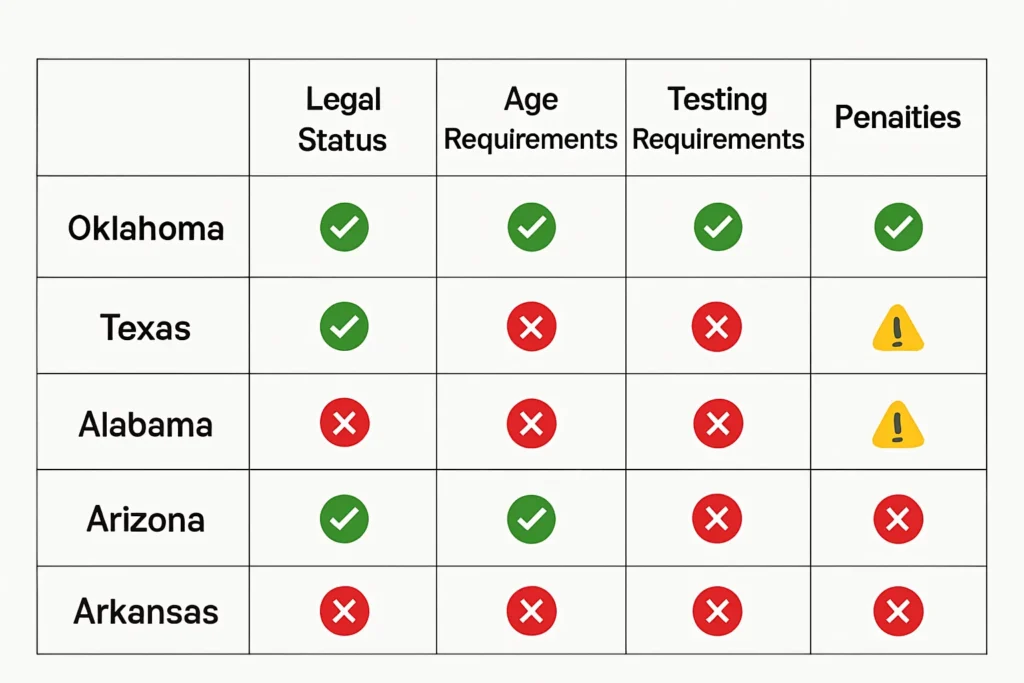
Comparing Oklahoma to Other States
Understanding how Oklahoma’s kratom laws compare to other states provides valuable context for the effectiveness and scope of the Sooner State’s regulatory approach. This comparison highlights different regulatory philosophies and their practical implications.
States with Similar KCPA-Based Laws
States Following Oklahoma’s Model
Several states have adopted similar comprehensive regulation:
🏛️ Arizona
- Age requirement: 18+
- Testing requirements: Comprehensive contaminant testing
- Labeling standards: Similar to Oklahoma’s requirements
- Enforcement: State-level oversight with local coordination
🏛️ Georgia
- Age requirement: 18+
- Testing requirements: Mandatory third-party testing
- Labeling standards: Detailed ingredient and warning requirements
- Enforcement: Department of Agriculture oversight
🏛️ Utah
- Age requirement: 18+
- Testing requirements: Heavy metal and contaminant testing
- Labeling standards: Comprehensive labeling mandates
- Enforcement: State health department coordination
Key Similarities
These states share several regulatory approaches:
- Consumer protection focus rather than prohibition
- Age restrictions to prevent minor access
- Quality standards ensuring product safety
- Vendor accountability through licensing and oversight
States with Prohibition
Complete Bans
Several states have chosen complete prohibition:
❌ Alabama
- Status: Complete ban since 2016
- Penalties: Criminal charges for possession and sale
- Enforcement: Active law enforcement priority
- Recent developments: No movement toward legalization
❌ Arkansas
- Status: Banned since 2016
- Penalties: Misdemeanor charges for violations
- Enforcement: State and local coordination
- Recent developments: Legislative discussions but no changes
❌ Indiana
- Status: Prohibited with limited exceptions
- Penalties: Felony charges for commercial activity
- Enforcement: Strict enforcement protocols
- Recent developments: Some advocacy for regulation vs. prohibition
Prohibition Rationale
States choosing prohibition often cite:
- Safety concerns about unregulated products
- Lack of FDA approval for therapeutic use
- Potential for abuse and dependency
- Limited research on long-term effects
States with Minimal Regulation
Unregulated Legal Status
Some states allow kratom with minimal oversight:
✅ Texas
- Status: Legal with age restrictions in some cities
- Regulation: Minimal state-level oversight
- Local variation: Cities may impose additional restrictions
- Market characteristics: Wide availability with variable quality
✅ Florida
- Status: Legal with some local restrictions
- Regulation: Limited state involvement
- Local variation: County and city-specific ordinances
- Market characteristics: Large market with diverse vendors
Minimal Regulation Characteristics
- Market-driven quality standards
- Limited government oversight of products
- Vendor self-regulation initiatives
- Consumer responsibility for product evaluation
Regulatory Effectiveness Analysis
Oklahoma’s Balanced Approach
Oklahoma’s model demonstrates several advantages:
✅ Consumer Protection Benefits
- Reduced risk of contaminated products
- Clear quality standards for vendors
- Age restrictions preventing minor access
- Transparent labeling for informed decisions
✅ Market Stability
- Predictable regulatory environment for businesses
- Level playing field for compliant vendors
- Consumer confidence in legal products
- Reduced black market activity
Challenges and Limitations
Even well-designed regulations face challenges:
⚠️ Implementation Issues
- Compliance costs may burden small vendors
- Enforcement resources require adequate funding
- Interstate commerce complications with varying state laws
- Federal uncertainty affects long-term planning
Frequently Asked Questions – Is Kratom Legal In Oklahoma
Is kratom legal in Oklahoma?
Yes, kratom is legal in Oklahoma for adults. The state allows the sale, possession, and use of kratom under specific consumer protection rules. These rules focus on product labeling and safety standards rather than banning the substance. Local jurisdictions generally follow state law, though regulations can change over time.
Does Oklahoma have a Kratom Consumer Protection Act?
Oklahoma has adopted a Kratom Consumer Protection Act that regulates how kratom products are sold. The law aims to protect consumers by setting quality and labeling standards rather than restricting access. It focuses on transparency and product safety instead of criminal penalties for users.
What rules do kratom sellers in Oklahoma have to follow?
- Products must list ingredients and alkaloid content clearly
- Synthetic additives are not allowed
- Products cannot be marketed to minors
- Labels must avoid misleading health claims
Is kratom legal to buy online in Oklahoma?
Buying kratom online is legal in Oklahoma if the seller complies with state regulations. Online vendors must follow the same labeling and safety standards as physical stores. Consumers are responsible for ensuring the product ships from a seller that follows Oklahoma law.
Are there age restrictions for buying kratom in Oklahoma?
- Sales are limited to adults only
- Retailers must verify buyer age
- Products cannot be advertised to minors
Can kratom be banned at the city or county level in Oklahoma?
Most cities and counties in Oklahoma follow state law regarding kratom. While local governments can pass ordinances, there are no widely enforced local bans that override state rules. It is still recommended to check local updates, especially when traveling within the state.
Is possession of kratom a crime in Oklahoma?
Possession of kratom is not considered a crime in Oklahoma when the product meets legal standards. Issues may arise only if a product violates consumer protection rules, such as containing prohibited additives or false labeling. Personal possession itself is not targeted by state law.
Are kratom extracts and powders treated differently under Oklahoma law?
- Both forms are legal if they meet safety standards
- Alkaloid levels must stay within allowed limits
- Products must disclose their form clearly on labels
Has kratom legality in Oklahoma changed in recent years?
Oklahoma shifted from uncertainty to regulation when consumer protection rules were introduced. Instead of banning kratom, lawmakers chose oversight focused on product quality. Since then, the legal status has remained stable, though updates are possible as policies evolve.
Could kratom become illegal in Oklahoma in the future?
Like any regulated product, kratom laws in Oklahoma could change through future legislation. Changes would depend on state lawmakers and regulatory reviews. For now, kratom remains legal under established rules, and no immediate statewide ban is in effect.
Conclusion
Oklahoma’s approach to kratom regulation represents a thoughtful balance between consumer protection and market access. Through the implementation of the Kratom Consumer Protection Act, the state has created a comprehensive framework that prioritizes safety while preserving legal access to kratom for adult consumers.
The key elements of Oklahoma’s kratom laws are clear and enforceable:
🔑 Essential Requirements
- 18+ age requirement for all kratom-related activities
- Comprehensive testing for contaminants and adulterants
- Detailed labeling standards ensuring consumer information
- Vendor licensing and accountability measures
- Quality standards that protect public health
Oklahoma’s regulatory model demonstrates that effective kratom oversight is possible without resorting to prohibition. The state’s experience provides valuable insights for other jurisdictions considering similar legislation and shows how collaborative stakeholder engagement can produce workable solutions.
Daniel Brooks
Daniel Brooks is a U.S. based botanical writer with over six years of hands on experience in kratom focused content. He studies kratom strains, sourcing standards, dosage patterns, and consumer safety topics. He stays up to date with current news, regulatory changes, and market trends related to kratom and botanical products.
His work includes educational guides, strain breakdowns, and vendor reviews written for everyday users. He avoids promotional language and presents clear facts. Daniel helps readers understand both benefits and risks so they can make informed choices about responsible kratom use.