
You’re browsing online for natural wellness products and come across kratom, a botanical substance that’s gained significant attention in recent years. As a New York resident, your first thought might be, “Is this even legal here?” With varying kratom laws across different states and ongoing legislative changes, understanding the legal landscape in New York can feel like navigating a maze. 🗽
- Kratom is currently legal in New York State for adults 18 and older
- The state has implemented the Kratom Consumer Protection Act with specific regulations
- Age restrictions prohibit sales to anyone under 18 years old
- Quality and labeling standards must be met by all vendors
- Local municipalities may have additional restrictions beyond state law
Understanding Kratom and Its Legal Status
Kratom (Mitragyna speciosa) is a tropical tree native to Southeast Asia, where its leaves have been traditionally used for centuries. In the United States, kratom has become increasingly popular as a botanical supplement, leading to a complex patchwork of state and federal regulations.
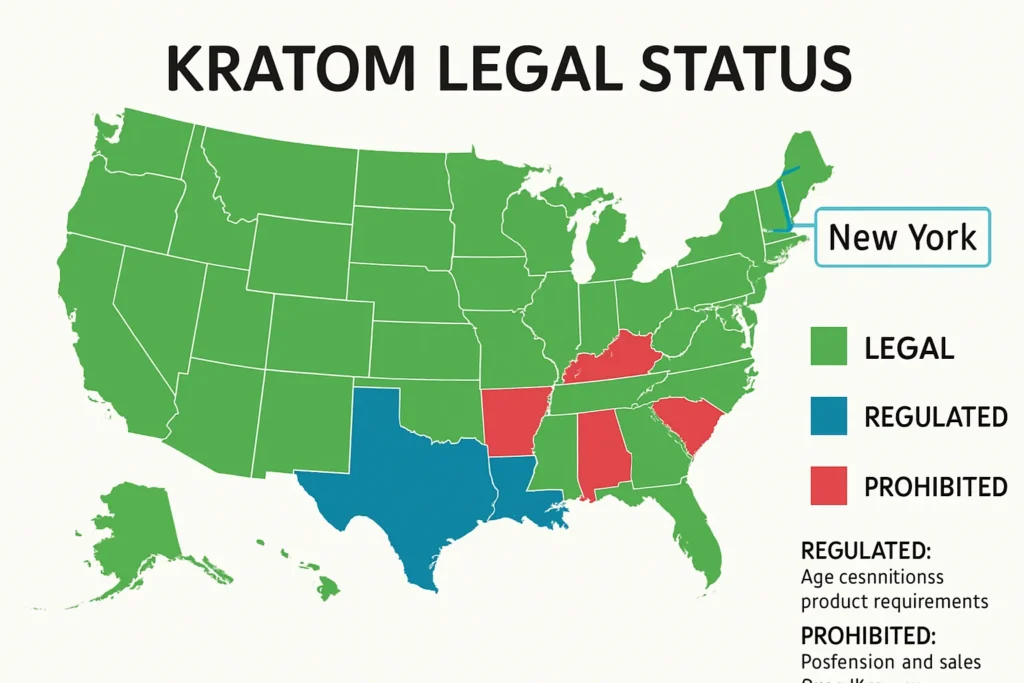
The legal status of kratom varies significantly across the United States. While some states have banned the substance entirely, others have embraced regulation through consumer protection acts. New York falls into the latter category, having established a framework that allows kratom sales while implementing safety measures.
Federal vs. State Jurisdiction
At the federal level, kratom remains unscheduled by the Drug Enforcement Administration (DEA), meaning it’s not classified as a controlled substance. However, the Food and Drug Administration (FDA) has not approved kratom for any medical use and continues to monitor its safety profile.
This federal approach leaves individual states with the authority to regulate kratom within their borders, resulting in the diverse legal landscape we see today.
Is Kratom Legal in New York? Current State Laws
Yes, kratom is legal in New York State, but with important regulations that consumers and vendors must follow. The state passed comprehensive kratom legislation that took effect in recent years, establishing New York as one of the states with clear regulatory frameworks for kratom products.
The New York Kratom Consumer Protection Act
New York’s approach to kratom regulation centers around the Kratom Consumer Protection Act, which provides a structured legal framework for the sale and distribution of kratom products. This legislation represents a balanced approach that prioritizes consumer safety while maintaining access to kratom for adults.
Key provisions of the Act include:
- Age restrictions: Sales limited to individuals 18 years and older
- Product testing requirements: Mandatory testing for contaminants and adulterants
- Labeling standards: Clear ingredient disclosure and warning labels
- Vendor licensing: Registration requirements for kratom retailers
- Quality control measures: Prohibition of adulterated or contaminated products
Legal Purchase and Possession
Under current New York law, adults aged 18 and older can legally:
✅ Purchase kratom products from licensed vendors
✅ Possess kratom for personal use
✅ Transport kratom within state boundaries
✅ Consume kratom products in private settings
However, there are restrictions on:
❌ Sales to minors (under 18 years old)
❌ Unlicensed commercial sales
❌ Adulterated or contaminated products
❌ Misbranded or mislabeled products
New York Kratom Legal Status Checker
Check if you can legally purchase and possess kratom in New York
Age Restrictions and Requirements
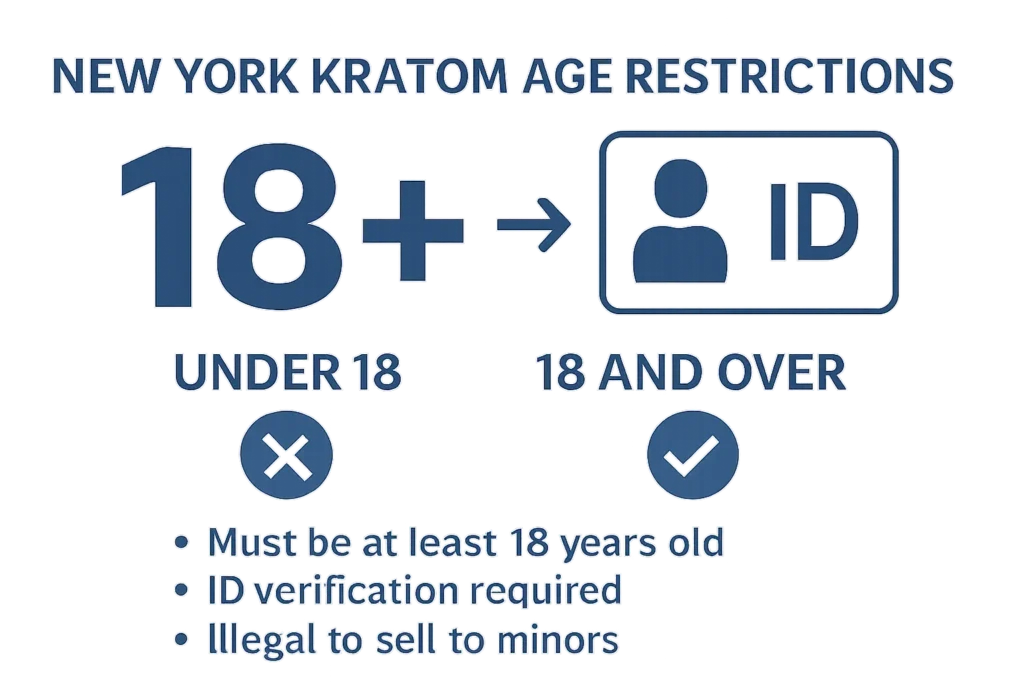
One of the most important aspects of New York’s kratom laws involves age restrictions. The state has implemented clear guidelines regarding who can legally purchase and possess kratom products.
Minimum Age Requirements
18 Years Old: This is the minimum age for kratom purchases in New York. Anyone under 18 cannot legally:
- Purchase kratom products
- Possess kratom (with limited exceptions for medical research)
- Receive kratom as a gift from adults
ID Verification Process
Licensed kratom vendors in New York must implement robust age verification systems:
In-Person Sales:
- Valid government-issued photo ID required
- Acceptable forms include driver’s license, state ID, passport, or military ID
- Vendors must visually inspect and verify the ID’s authenticity
- Some retailers may use electronic ID scanning systems
Online Sales:
- Age verification software integration
- Credit card age verification
- Additional identity confirmation may be required
- Delivery drivers may request ID upon delivery
Penalties for Underage Sales
The consequences for selling kratom to minors in New York are significant:
For Vendors:
- Civil penalties ranging from $500 to $2,000 per violation
- Potential license suspension or revocation
- Criminal charges in cases of willful violation
- Increased regulatory scrutiny and inspections
For Minors:
- Confiscation of kratom products
- Potential juvenile court referral
- Educational intervention programs
- Notification of parents or guardians
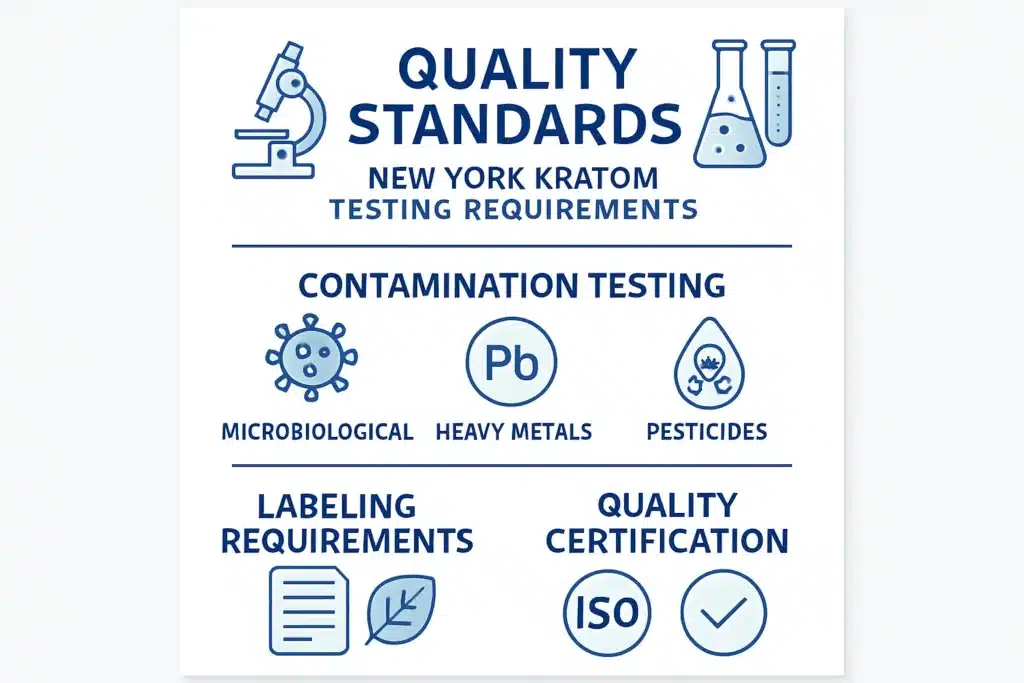
Quality Standards and Vendor Requirements
New York’s regulatory framework extends beyond age restrictions to encompass comprehensive quality and safety standards that all kratom vendors must meet.
Product Testing Requirements
Mandatory Testing includes screening for:
🧪 Contaminants:
- Heavy metals (lead, mercury, cadmium, arsenic)
- Pesticides and herbicides
- Microbial contaminants (E. coli, Salmonella)
- Yeast and mold
🧪 Adulterants:
- Synthetic compounds
- Pharmaceutical drugs
- Controlled substances
- Undisclosed additives
Labeling and Packaging Standards
All kratom products sold in New York must include:
Required Label Information:
- Product name and kratom strain
- Net weight or volume
- Ingredient list (all components)
- Manufacturer or distributor information
- Batch or lot numbers for traceability
- Testing certification references
Warning Labels:
- “Not for use by minors”
- “Not evaluated by the FDA”
- “Not intended to diagnose, treat, cure, or prevent any disease”
- Potential side effects and interactions
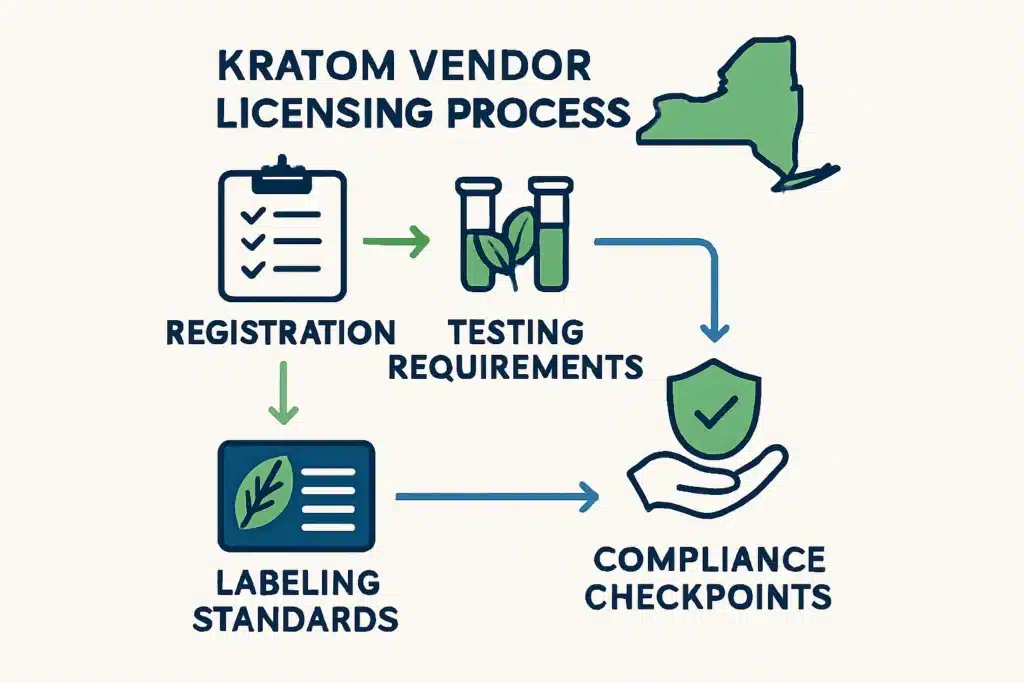
Vendor Licensing Process
To legally sell kratom in New York, vendors must:
- Register with appropriate state agencies
- Submit detailed business and product information
- Provide testing documentation for all products
- Implement age verification systems
- Maintain detailed sales and inventory records
- Submit to regular inspections and audits
For those interested in learning more about quality kratom products and vendors, understanding these regulations helps ensure you’re purchasing from compliant sources.
Local Municipality Variations
While New York State has established overarching kratom regulations, individual cities, towns, and counties may implement additional restrictions or requirements.
Common Local Restrictions
Zoning Limitations:
- Distance requirements from schools or daycare centers
- Restrictions on kratom shops in certain commercial zones
- Limitations on advertising and signage
Additional Licensing:
- Local business permits beyond state requirements
- Health department approvals
- Special use permits for kratom retailers
Enhanced Age Verification:
- Stricter ID checking requirements
- Additional staff training mandates
- Enhanced record-keeping obligations
Major Cities and Their Policies
New York City:
- Follows state regulations with additional business licensing
- Enhanced inspection protocols
- Stricter advertising restrictions
Buffalo:
- Standard state compliance required
- Local business permit necessary
- Regular health department oversight
Rochester:
- Aligned with state laws
- Additional zoning considerations
- Community notification requirements
Syracuse:
- State regulation compliance
- Local tax obligations
- Enhanced vendor registration
It’s crucial for both consumers and vendors to research local ordinances in their specific municipalities, as these can vary significantly even within the same county.
Purchasing Kratom Legally in New York
Understanding where and how to purchase kratom legally in New York ensures compliance with state regulations while accessing quality products.
Licensed Retail Locations
Physical Stores:
Licensed kratom retailers in New York typically include:
- Specialized botanical shops
- Smoke shops with proper licensing
- Health and wellness stores
- Some convenience stores (with proper permits)
When visiting physical locations, look for:
✅ Valid business licenses displayed
✅ Age verification procedures
✅ Product testing certificates available
✅ Proper labeling on all products
✅ Knowledgeable staff familiar with regulations
Online Purchasing Guidelines
Reputable Online Vendors should provide:
- Clear age verification processes
- Detailed product information and lab testing results
- Compliance statements regarding New York regulations
- Secure payment processing
- Proper shipping and delivery procedures
For those seeking information about where to buy quality kratom products, it’s essential to verify that online vendors comply with New York’s specific requirements.
Red Flags to Avoid
Warning Signs of non-compliant vendors:
❌ No age verification process
❌ Lack of product testing documentation
❌ Missing or inadequate labeling
❌ Unrealistic claims about kratom’s effects
❌ Prices significantly below market rates
❌ No business registration information
❌ Poor customer service or communication
Kratom Product Types and Legal Considerations
New York’s regulations apply to all forms of kratom products, but understanding the different types available can help consumers make informed legal purchases.
Common Kratom Product Forms
Kratom Powder:
- Most traditional and widely available form
- Subject to all testing and labeling requirements
- Often the most cost-effective option
- Requires proper storage to maintain quality
Kratom Capsules:
Understanding how many kratom capsules to take is important for responsible use, and all capsule products must meet the same regulatory standards as powder forms.
Kratom Extracts:
- Concentrated forms with higher potency
- Subject to additional testing requirements
- Must clearly indicate concentration levels
- Often require enhanced warning labels
For those interested in learning about how to make kratom extract, it’s important to note that home extraction for personal use is legal, but commercial extract production requires full regulatory compliance.
Strain Varieties and Legal Status
All kratom strains are subject to the same legal requirements in New York, regardless of their origin or characteristics:
Popular Strains Include:
- White Hulu Kapuas Kratom
- Yellow Hulu Kapuas Kratom
- Red Bali varieties
- Green Maeng Da types
- Various regional strains
Each strain must undergo the same testing and labeling procedures, ensuring consistent quality and safety standards across all varieties.
Transportation and Possession Laws
Understanding the legal aspects of transporting and possessing kratom in New York helps ensure compliance during travel and daily use.
Intrastate Transportation
Within New York State:
- Legal for adults 18+ to transport kratom
- No quantity limits for personal use
- Products should remain in original packaging when possible
- Keep receipts and lab testing documentation
Vehicle Storage:
- Store kratom in a cool, dry place
- Avoid extreme temperatures that could degrade quality
- Keep products in clearly labeled containers
- Maintain proof of legal purchase
Interstate Travel Considerations
Traveling to Other States:
Before crossing state lines with kratom, research the destination state’s laws:
- Some states completely prohibit kratom
- Others have different age restrictions
- Possession limits may vary
- Local ordinances might apply
Traveling from Other States:
When bringing kratom into New York:
- Ensure products meet New York’s quality standards
- Verify age compliance (18+ requirement)
- Be prepared to show proof of legal purchase
- Consider purchasing from New York-licensed vendors instead
For reference, you might want to check the legal status in other states, such as kratom laws in Georgia or kratom regulations in Oklahoma, which may differ significantly from New York’s approach.
Workplace and Public Use Considerations
While kratom may be legal to possess and use in New York, there are important considerations regarding workplace policies and public consumption.
Employment Implications
Workplace Policies:
- Employers may prohibit kratom use during work hours
- Drug testing policies might include kratom screening
- Safety-sensitive positions may have stricter restrictions
- Professional licenses could be affected by kratom use
Best Practices:
- Review employee handbooks for substance policies
- Consult with HR departments about specific policies
- Consider timing of use relative to work responsibilities
- Understand that legal doesn’t always mean acceptable in all contexts
Public Consumption Guidelines
Appropriate Settings:
- Private residences and properties
- Designated areas where permitted
- Personal vehicles (when not driving)
- Some private establishments that allow it
Inappropriate Settings:
- Schools and educational facilities
- Government buildings
- Public transportation
- Areas where minors are present
- Workplaces (unless specifically permitted)
Comparing New York to Federal Regulations
Understanding how New York’s kratom laws relate to federal oversight provides important context for consumers and vendors.
Federal Agency Positions
DEA Stance:
- Kratom remains unscheduled federally
- No current plans for immediate scheduling
- Continues monitoring for public health concerns
- Defers to state-level regulation in most cases
FDA Position:
- Has not approved kratom for any medical use
- Continues issuing warnings about potential risks
- Monitors adverse event reports
- Maintains import alerts for certain kratom products
State vs. Federal Authority
New York’s Approach:
- Proactive regulation rather than prohibition
- Focus on consumer protection and safety
- Age restrictions and quality standards
- Licensed vendor requirements
This regulatory approach positions New York as a state that recognizes kratom use while prioritizing public health and safety through comprehensive oversight.
Penalties for Violations
Understanding the consequences of violating New York’s kratom laws helps ensure compliance and avoid legal issues.
Consumer Violations
Underage Possession:
- Confiscation of products
- Potential juvenile court referral
- Educational intervention programs
- Parental notification
Improper Use:
- Public consumption violations
- Workplace policy infractions
- Potential civil penalties in some municipalities
Vendor Violations
Licensing Violations:
- Fines ranging from $1,000 to $10,000
- License suspension or revocation
- Mandatory compliance training
- Enhanced inspection requirements
Product Quality Violations:
- Immediate product recall orders
- Civil penalties up to $25,000
- Criminal charges for knowing violations
- Permanent business closure in severe cases
Age Verification Failures:
- $500 to $2,000 per violation
- Mandatory staff retraining
- Enhanced monitoring requirements
- Potential license review
Consumer Safety and Best Practices
Beyond legal compliance, understanding safety best practices helps ensure responsible kratom use in New York.
Choosing Quality Products
Verification Steps:
- Check vendor licensing with state authorities
- Review lab testing results for all products
- Verify proper labeling and warning information
- Research vendor reputation and customer reviews
- Confirm age verification processes are in place
Quality Indicators:
- Third-party laboratory testing
- Certificates of analysis (COA) availability
- Clear batch tracking and lot numbers
- Professional packaging and labeling
- Responsive customer service
Responsible Use Guidelines
Start Small:
- Begin with minimal amounts to assess tolerance
- Allow time between uses to evaluate effects
- Keep detailed records of use and responses
- Consult healthcare providers when appropriate
Storage and Handling:
- Store in cool, dry places away from direct sunlight
- Keep products in original packaging when possible
- Maintain separation from food and medications
- Ensure products remain inaccessible to minors
For additional guidance on responsible use, including information about the best places to find kratom drinks and where to buy them, consumers should prioritize vendors who emphasize safety and compliance.
Frequently Asked Questions – Is Kratom Legal in New York
Is kratom legal in New York?
Kratom is legal in New York at the state level. New York law does not classify kratom as a controlled substance, and there is no statewide ban in effect. Adults can possess and use kratom under current rules. Laws can change, so residents should stay informed about updates at both state and local levels.
Can you buy kratom in New York?
Kratom can be purchased in New York through various channels. Availability depends on the seller and location, but there is no state law prohibiting sales.
- Physical smoke shops and specialty stores may sell kratom
- Online vendors can ship kratom to New York addresses
- Product availability varies by retailer
Is kratom legal in New York City?
Kratom is legal in New York City under current regulations. The city follows New York State law, which allows kratom possession and sale. There is no separate citywide ban in place. Consumers should still be aware that enforcement practices and store policies can differ across boroughs and individual businesses.
Are there any local bans on kratom in New York?
As of now, there are no widely enforced county or city bans on kratom in New York. Most local jurisdictions follow state law.
- No confirmed statewide local prohibitions
- Local councils can propose restrictions
- Regulations may change without notice
Is kratom regulated by New York State?
New York State does not have a specific kratom regulatory framework in place. Kratom is not approved as a drug or dietary supplement under state law. This means there are limited rules on labeling, purity, or quality. Consumers rely largely on vendor standards and general consumer protection laws.
Can you possess kratom in New York?
Personal possession of kratom is allowed in New York. There are no state laws that criminalize owning or holding kratom products for personal use. Possession limits are not defined in statute. Standard laws related to public safety and commerce still apply when transporting or storing kratom.
Is kratom legal for shipping to New York?
Kratom can be shipped to New York from online sellers under current law.
- Interstate shipping to New York is generally permitted
- Some vendors restrict shipping by policy
- Carrier rules may affect delivery options
Can kratom laws change in New York?
Kratom laws in New York can change through new legislation or regulatory action. Bills related to kratom have been proposed in the past, showing ongoing interest by lawmakers. Future rules could involve restrictions, age limits, or quality standards. Staying updated through official state sources is recommended.
Is kratom treated the same as marijuana in New York?
Kratom and marijuana are treated differently under New York law. Marijuana is regulated with defined legal frameworks, licensing, and taxation. Kratom does not have a comparable system. It remains legal but largely unregulated, which places it in a separate legal category with fewer formal consumer protections.
Conclusion
Is kratom legal in New York? Yes, kratom is legal in New York State for adults 18 and older, but with important regulations that prioritize consumer safety and product quality. The state’s comprehensive Kratom Consumer Protection Act establishes clear guidelines for vendors and consumers while maintaining access to kratom products.
🔸 Age requirement: Must be 18 or older to purchase and possess kratom
🔸 Quality standards: All products must meet testing and labeling requirements
🔸 Licensed vendors: Purchase only from properly registered retailers
🔸 Local variations: Check municipal ordinances for additional restrictions
🔸 Responsible use: Follow safety guidelines and workplace policies
Next steps for consumers:
- Verify vendor licensing before making purchases
- Request lab testing results for all kratom products
- Stay informed about regulatory updates and changes
- Practice responsible use and storage procedures
- Consult healthcare providers when appropriate
For vendors and businesses:
- Obtain proper licensing and maintain compliance
- Implement robust testing and quality control systems
- Establish effective age verification procedures
- Stay current with regulatory requirements
- Invest in staff training and customer education
As New York’s kratom regulations continue to evolve, staying informed about legal requirements and industry best practices ensures safe, compliant access to kratom products. Whether you’re a consumer seeking quality products or a business owner navigating regulatory requirements, understanding these laws helps create a safer, more transparent kratom marketplace in the Empire State.
Daniel Brooks
Daniel Brooks is a U.S. based botanical writer with over six years of hands on experience in kratom focused content. He studies kratom strains, sourcing standards, dosage patterns, and consumer safety topics. He stays up to date with current news, regulatory changes, and market trends related to kratom and botanical products.
His work includes educational guides, strain breakdowns, and vendor reviews written for everyday users. He avoids promotional language and presents clear facts. Daniel helps readers understand both benefits and risks so they can make informed choices about responsible kratom use.