
The Silver State’s relationship with kratom has been anything but simple. While millions of Americans use this Southeast Asian botanical for various purposes, Nevada residents have faced unique legal challenges that make understanding the current status crucial for anyone considering kratom use or purchase in the state.
Nevada’s kratom laws have evolved significantly over recent years, creating confusion among consumers and retailers alike. Unlike some states with clear-cut bans or complete freedom, Nevada operates in a more complex legal landscape that requires careful navigation. Whether you’re a current user, considering trying kratom, or simply curious about the legal framework, understanding these regulations is essential for staying compliant and safe.
Understanding Nevada’s Current Kratom Legal Status
Is kratom legal in Nevada? The answer is yes, but with important caveats. As of now, kratom remains legal for adults aged 21 and older throughout Nevada. This age restriction sets Nevada apart from many other states where kratom is legal for all adults 18 and older.
The legal status in Nevada has been shaped by legislative attempts and regulatory discussions over the past several years. In 2019, the state considered legislation that would have banned kratom entirely, but these efforts ultimately failed. Instead, Nevada has maintained a regulatory approach that allows kratom use while implementing age restrictions.
Current Legal Framework
Nevada’s approach to kratom regulation focuses on:
- Age restrictions: Must be 21 or older to purchase or possess
- No statewide ban: Kratom remains legal across all counties
- Retail regulations: Vendors must comply with labeling requirements
- Quality standards: Products must meet basic safety guidelines
The state has not adopted the Kratom Consumer Protection Act (KCPA), which many other states have implemented to create comprehensive regulatory frameworks. This means Nevada operates under a more basic legal structure compared to states with detailed kratom legislation.
Historical Context of Kratom Legislation in Nevada
Understanding how Nevada arrived at its current kratom laws provides valuable context for residents and visitors. The state’s legislative journey with kratom reflects broader national debates about botanical regulation and public health policy.
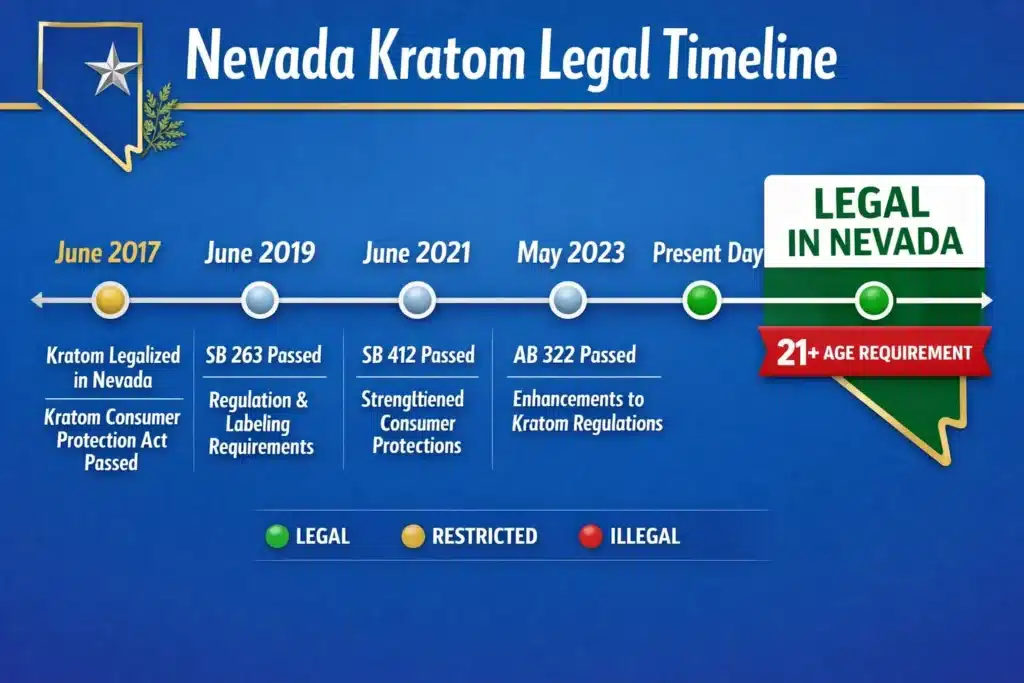
Legislative Timeline
2017-2018: Initial discussions about kratom regulation began in Nevada as federal agencies raised concerns about the botanical’s safety profile.
2019: Nevada lawmakers introduced Assembly Bill 135, which would have classified kratom as a controlled substance. The bill gained initial support but faced opposition from advocates and users who testified about kratom’s benefits.
2020-2021: Instead of pursuing a complete ban, Nevada opted for age restrictions and basic regulatory oversight, similar to alcohol regulation models.
2022-Present: The current framework has remained stable, with no major legislative changes proposed or enacted.
This evolution demonstrates Nevada’s measured approach to kratom regulation, balancing public health concerns with individual freedom and access rights.
Legal Purchasing Requirements and Restrictions
When purchasing kratom in Nevada, consumers must navigate specific requirements that differ from many other states. These regulations affect both buyers and sellers, creating a structured marketplace for kratom products.
Age Verification Requirements
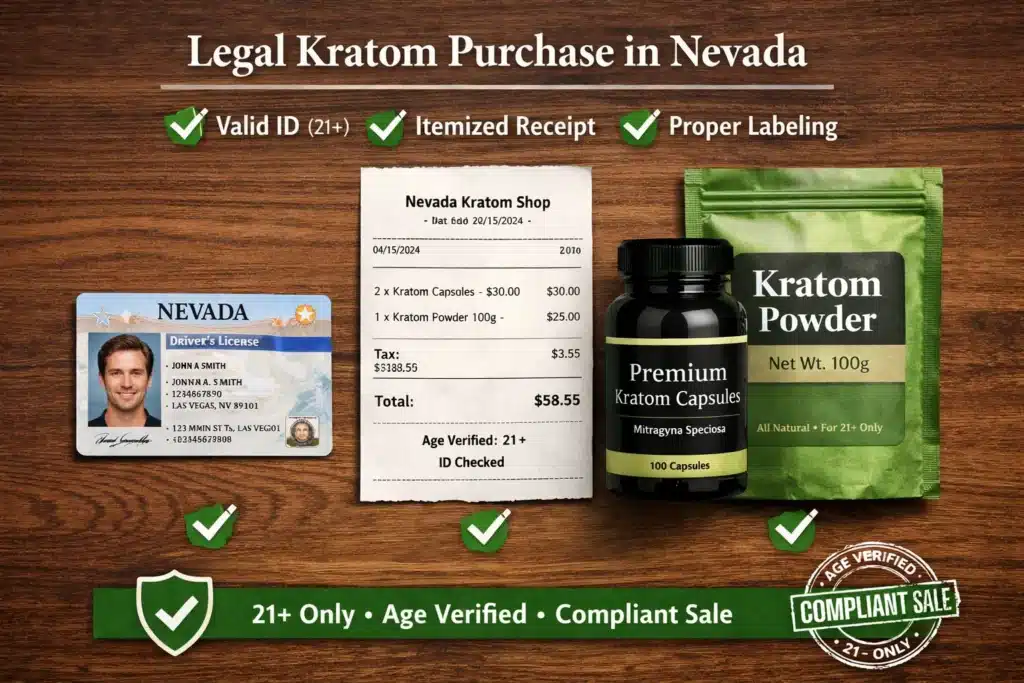
All kratom purchases in Nevada require strict age verification:
- Valid identification: Government-issued ID showing birth date
- 21-year minimum: No exceptions for medical use or parental consent
- Retail compliance: Stores must verify age for every transaction
- Online purchases: Age verification required for delivery within Nevada
Approved Retail Channels
Kratom can be legally purchased through several channels in Nevada:
- Licensed smoke shops and botanical retailers
- Online vendors shipping to Nevada addresses
- Specialty kratom stores with proper licensing
- Some gas stations and convenience stores
However, kratom cannot be sold through:
- Vending machines
- Unlicensed street vendors
- Establishments without proper business licenses
For those looking to purchase quality kratom products, exploring reputable kratom powder options ensures compliance with Nevada’s quality standards.
Nevada Kratom Legal Status Checker
Check if kratom is legal for you in Nevada based on your age and intended use
Must be 21 or older to legally purchase or possess kratom in Nevada
Legal in all Nevada counties with proper age verification
Licensed retailers, online vendors, and specialty stores
Potential Legal Risks and Consequences
While kratom is legal in Nevada for adults 21 and older, users still face potential legal risks that require careful consideration. Understanding these risks helps consumers make informed decisions and avoid unintended legal complications.
Age-Related Violations
The most common legal issue involves age violations:
- Underage possession: Individuals under 21 caught with kratom may face misdemeanor charges
- Providing to minors: Adults who give kratom to anyone under 21 risk serious legal consequences
- Fake identification: Using false ID to purchase kratom compounds legal problems significantly
Quality and Labeling Issues
Nevada’s regulations require proper labeling and quality standards:
- Mislabeled products: Purchasing or selling improperly labeled kratom can create liability
- Contaminated products: Products failing safety standards may result in health department action
- False claims: Vendors making medical claims face regulatory enforcement
Federal Considerations
Despite state legality, federal agencies continue monitoring kratom:
- FDA warnings: The Food and Drug Administration maintains concerns about kratom safety
- Import restrictions: Federal agencies may seize kratom shipments at borders
- Banking limitations: Financial institutions may restrict kratom-related transactions
For those seeking reliable sources, reputable kratom vendors typically provide proper documentation and quality assurance to minimize these risks.
Safe and Legal Buying Practices in Nevada
Purchasing kratom legally and safely in Nevada requires following established best practices that protect both consumers and vendors. These guidelines help ensure compliance with state regulations while maximizing product quality and safety.
Vendor Verification
Before purchasing kratom in Nevada, verify that vendors meet legal requirements:
- Business licensing: Ensure retailers have proper Nevada business licenses
- Age verification systems: Confirm vendors check identification consistently
- Quality testing: Look for vendors providing third-party lab results
- Proper labeling: Products should include ingredient lists and safety warnings
Documentation and Records
Maintaining proper documentation protects consumers:
- Purchase receipts: Keep records of all kratom purchases
- Product information: Save labeling and ingredient details
- Vendor contact information: Maintain seller details for potential issues
- Lab results: Store any quality testing documentation provided
Quality Assessment
Evaluating kratom quality before purchase helps ensure safety:
- Visual inspection: Quality kratom should have consistent color and texture
- Packaging integrity: Products should be properly sealed and labeled
- Expiration dates: Check for freshness and proper storage recommendations
- Third-party testing: Prefer vendors offering independent lab verification
Those interested in exploring different kratom varieties can find specialized gold kratom powder options that meet Nevada’s quality standards.
Understanding Kratom Product Types and Regulations
Nevada’s legal framework applies to all kratom product types, but different forms may have varying regulatory considerations. Understanding these distinctions helps consumers make informed choices while staying compliant with state laws.
Kratom Powder Regulations
Kratom powder represents the most common form sold in Nevada:
- Purity requirements: Must contain only kratom leaf material
- Labeling standards: Scientific name (Mitragyna speciosa) must appear on packaging
- Serving suggestions: Cannot include medical dosage recommendations
- Storage instructions: Must include proper storage guidance
Extract and Concentrate Rules
Concentrated kratom products face additional scrutiny:
- Potency labeling: Concentration ratios must be clearly stated
- Warning labels: Enhanced warning requirements for concentrated products
- Age verification: Extra verification may be required for high-potency items
- Quantity restrictions: Some retailers limit purchase amounts
Capsule and Pre-Made Products
Encapsulated kratom follows supplement-style regulations:
- Ingredient disclosure: All capsule contents must be listed
- Manufacturing standards: Must follow good manufacturing practices
- Expiration dating: Shelf life information required
- Tamper-evident packaging: Safety seals necessary for consumer protection
Workplace and Employment Considerations
Nevada employees should understand how kratom use might affect their employment, even though the substance remains legal in the state. Workplace policies often differ from legal status, creating potential conflicts for users.
Employment Policies
Many Nevada employers maintain drug-free workplace policies that may include kratom:
- Pre-employment screening: Some companies test for kratom alkaloids
- Random testing: Ongoing employment may require periodic drug screens
- Reasonable suspicion: Employers can test based on performance concerns
- Post-incident testing: Workplace accidents may trigger comprehensive screening
Industry-Specific Restrictions
Certain industries face stricter regulations regardless of state legality:
- Transportation: DOT-regulated positions may prohibit kratom use
- Healthcare: Medical facilities often maintain comprehensive substance policies
- Government positions: Federal employees face federal regulations, not state laws
- Safety-sensitive roles: Jobs involving heavy machinery may restrict kratom use
Legal Protections
Nevada workers have limited protections regarding kratom use:
- No employment protection: Legal status doesn’t guarantee job protection
- At-will employment: Employers can generally terminate for kratom use
- Union contracts: Collective bargaining agreements may provide some protections
- Medical accommodations: Limited legal framework for medical kratom use
Health and Safety Considerations
While focusing on legal aspects, understanding health and safety considerations helps Nevada kratom users make responsible decisions. These factors complement legal compliance and promote safer use practices.
Interaction Awareness
Kratom may interact with various substances and medications:
- Prescription medications: Consult healthcare providers about potential interactions
- Alcohol combination: Mixing kratom and alcohol increases health risks
- Other botanicals: Multiple substance use compounds potential effects
- Medical conditions: Certain health conditions may contraindicate kratom use
Quality Control Importance
Nevada’s legal market emphasizes quality control for consumer safety:
- Contamination risks: Unregulated products may contain harmful substances
- Potency variation: Inconsistent products create unpredictable effects
- Adulteration concerns: Some products contain undisclosed additives
- Storage degradation: Improper storage affects product quality and safety
For those prioritizing quality and safety, contacting reputable vendors provides access to detailed product information and safety data.
Responsible Use Guidelines
Nevada users should follow responsible use practices:
- Start low: Begin with minimal amounts to assess individual response
- Monitor effects: Track how kratom affects personal well-being
- Avoid daily use: Regular use may lead to tolerance and dependence
- Seek guidance: Consult healthcare providers with questions or concerns
Local Ordinances and Municipal Regulations
While Nevada maintains statewide kratom legality, individual municipalities may implement additional regulations that affect local availability and use. Understanding these local variations helps ensure complete legal compliance.
City-Level Regulations
Major Nevada cities have taken different approaches to kratom regulation:
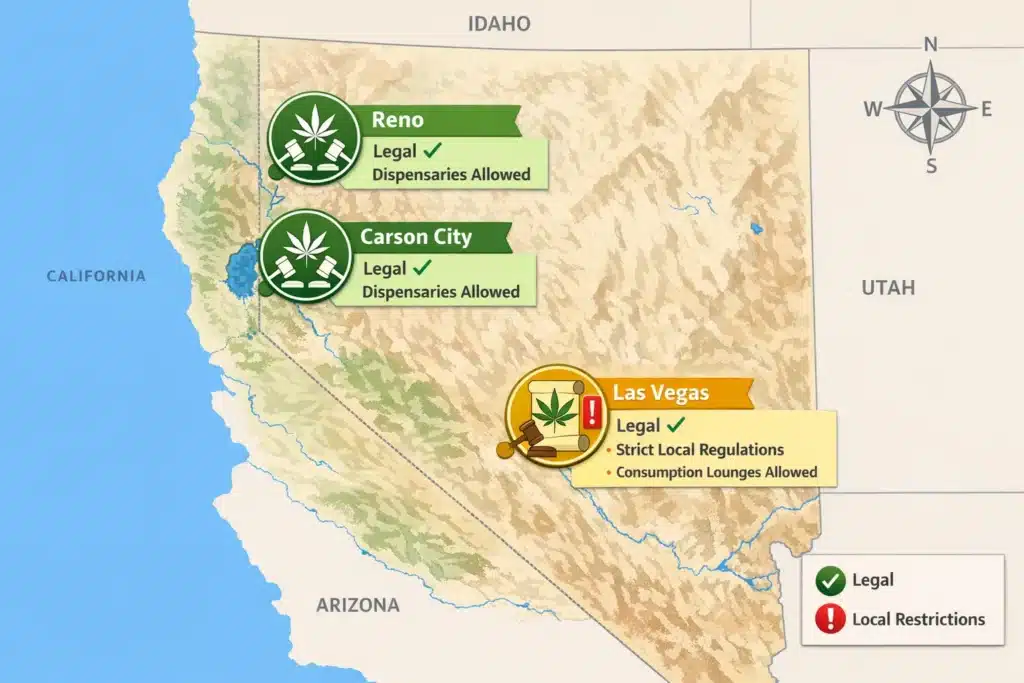
Las Vegas: Follows state guidelines with standard business licensing requirements for kratom retailers. No additional city-specific restrictions currently exist.
Reno: Maintains state-level compliance with enhanced business licensing scrutiny for kratom vendors. Regular inspections ensure quality standards.
Henderson: Implements standard state regulations with additional zoning restrictions for kratom retail locations.
Carson City: As the state capital, follows strict state guidelines with no additional municipal restrictions.
Zoning and Business Regulations
Local zoning laws affect where kratom can be sold:
- Retail zoning: Kratom sales typically require commercial retail zoning
- Distance restrictions: Some areas limit kratom sales near schools or parks
- Business licensing: Municipal licenses required in addition to state permits
- Operating hours: Local ordinances may restrict sales times
Future Municipal Considerations
Nevada cities continue evaluating kratom regulation:
- Public health assessments: Ongoing evaluation of kratom’s community impact
- Business regulation updates: Potential changes to vendor requirements
- Zoning modifications: Possible adjustments to retail location restrictions
- Consumer protection measures: Enhanced labeling or quality requirements
Traveling with Kratom in Nevada
Nevada residents and visitors should understand regulations governing kratom transportation and possession while traveling within the state and beyond. These considerations help avoid legal complications during travel.
Intrastate Travel
Traveling within Nevada with kratom requires following state guidelines:
- Age verification: Carry valid identification proving 21+ age
- Original packaging: Keep kratom in original labeled containers
- Quantity considerations: Avoid carrying excessive amounts that suggest distribution
- Documentation: Maintain purchase receipts for verification if questioned
Interstate Travel Considerations
Leaving Nevada with kratom requires understanding destination state laws:
- Legal status research: Verify kratom legality in destination states
- Transportation routes: Consider laws in states you’ll travel through
- Airport security: Understand TSA policies regarding kratom in luggage
- Border crossings: International travel with kratom requires careful research
Vehicle Transportation
Transporting kratom in vehicles within Nevada follows general guidelines:
- Passenger accessibility: Keep kratom in passenger areas, not trunks
- Original containers: Maintain manufacturer packaging and labeling
- Separation from other substances: Store kratom separately from alcohol or other substances
- Quantity reasonableness: Carry amounts consistent with personal use
For travelers seeking convenient kratom access, online ordering allows for reliable delivery to Nevada addresses.
Advocacy and Legal Resources
Nevada kratom users benefit from understanding available advocacy resources and legal support options. These resources help protect user rights and provide guidance during legal challenges.
Advocacy Organizations
Several organizations work to protect kratom access in Nevada:
- American Kratom Association (AKA): National organization providing Nevada-specific legal updates
- Local advocacy groups: Nevada-based organizations supporting kratom access rights
- Consumer protection groups: Organizations focusing on supplement and botanical rights
- Legislative monitoring services: Groups tracking Nevada kratom legislation
Legal Support Resources
Nevada kratom users can access various legal resources:
- Criminal defense attorneys: Lawyers experienced with botanical and supplement law
- Consumer protection services: State agencies handling vendor disputes
- Legal aid organizations: Low-cost legal assistance for kratom-related issues
- Professional associations: Bar association referral services for specialized attorneys
Staying Informed
Keeping current with Nevada kratom laws requires ongoing attention:
- Legislative tracking: Monitor Nevada legislature for kratom-related bills
- News sources: Follow local news for kratom regulatory updates
- Vendor communications: Stay connected with reputable vendors for legal updates
- Professional networks: Connect with other Nevada kratom users for information sharing
Monitoring Legal Changes and Updates
Nevada’s kratom legal landscape continues evolving, making ongoing monitoring essential for users, vendors, and advocates. Staying informed helps ensure continued compliance and preparedness for potential changes.
Legislative Monitoring
Tracking Nevada’s legislative process helps anticipate kratom law changes:
- Bill introductions: Monitor new legislation affecting kratom regulation
- Committee hearings: Follow legislative committee discussions about kratom
- Voting schedules: Track when kratom-related bills face votes
- Governor actions: Monitor executive branch positions on kratom regulation
Regulatory Updates
Administrative agencies may implement kratom regulations:
- Health department actions: Monitor public health agency kratom policies
- Business licensing changes: Track modifications to vendor requirements
- Quality standards updates: Follow changes to product testing requirements
- Enforcement priorities: Understand how agencies prioritize kratom enforcement
Federal Developments
Federal actions can affect Nevada’s kratom landscape:
- FDA policy changes: Monitor federal agency positions on kratom
- DEA scheduling considerations: Track potential federal scheduling actions
- Congressional activity: Follow federal legislative developments
- Interstate commerce regulations: Understand federal shipping and transport rules
Frequently Asked Questions – Is Kratom Legal In Nevada
Is kratom legal in Nevada?
Kratom is legal to possess and use in Nevada at the state level. There is no statewide law that bans kratom or its active compounds. This means adults can generally buy, have, and use kratom in Nevada, although local rules in specific cities or counties may still apply.
Can you buy kratom in Nevada?
Yes, kratom can be purchased in Nevada through several common retail channels. These include the following options.
- Smoke shops and vape stores
- Herbal and supplement shops
- Convenience stores
- Online kratom retailers
Is kratom legal in Las Vegas?
Las Vegas follows Nevada state law, which allows kratom. There is no current citywide ban in place. However, local business rules or zoning policies may affect where it can be sold. People should always check local updates since city regulations can change independently of state law.
Are there any age limits for buying kratom in Nevada?
Nevada does not have a specific statewide age limit written into kratom law. Many sellers choose to restrict sales to adults based on store policy or general supplement rules. This means age requirements may vary by retailer even though state law does not clearly set one.
Can kratom be shipped to Nevada?
Yes, kratom can be shipped to Nevada from most online vendors. Since the state allows kratom, shipping companies generally deliver it without issue. Orders may still be refused if a seller follows its own internal rules or if a local address falls under a special restriction.
Are there any local kratom bans in Nevada?
Some local governments may create their own rules about kratom sales. These rules can affect the following areas.
- Where kratom can be sold
- Which stores can carry it
- Labeling or packaging rules
- Local enforcement policies
Is kratom regulated in Nevada?
Nevada does not have a detailed kratom specific regulatory system at the state level. Kratom is generally treated like other herbal products. This means product safety, labeling, and quality standards depend mostly on general consumer product laws rather than kratom focused regulations.
Can you travel with kratom inside Nevada?
You can legally carry kratom within Nevada as long as you stay inside the state. It is treated as a legal herbal product. People should still store it in its original packaging when possible to avoid confusion during travel or if asked about it by authorities.
What happens if kratom laws change in Nevada?
If laws change, they usually follow a clear process. This often includes the following steps.
- A bill introduced by lawmakers
- Public hearings or committee reviews
- A vote in the state legislature
- Approval or rejection by the governor
Is kratom considered a controlled substance in Nevada?
Kratom is not listed as a controlled substance under Nevada law. This means it is not grouped with drugs that are illegal to possess or sell. It remains classified as a legal plant based product at the state level, subject to general consumer laws.
Conclusion
Nevada’s kratom legal landscape presents both opportunities and responsibilities for users throughout the Silver State. While kratom remains legal for adults 21 and older, navigating the regulatory environment requires understanding age restrictions, purchasing requirements, and ongoing compliance obligations.
The state’s measured approach to kratom regulation reflects broader trends toward evidence-based policy making rather than prohibition-focused strategies. This framework allows adult access while implementing basic safety measures and age protections. However, users must remain vigilant about potential legal changes and maintain compliance with existing regulations.
Key actions for Nevada kratom users include verifying vendor legitimacy, maintaining proper documentation, staying informed about legal developments, and practicing responsible use. The legal status provides opportunities for quality-assured products and legitimate business relationships, but also requires ongoing attention to regulatory compliance.
Nevada’s kratom community can help protect access rights through responsible use, community engagement, and support for compliant businesses. By working together and maintaining high standards, users and vendors can preserve the legal framework that currently allows kratom access throughout the state.
Moving forward, continued monitoring of legislative developments, federal policy changes, and local ordinances will be essential for maintaining legal compliance and protecting access rights. Nevada kratom users who stay informed, practice responsible use, and engage constructively with their communities will be best positioned to navigate future legal developments while enjoying the benefits of legal kratom access.
Whether you’re a long-time Nevada resident or new to the state, understanding these legal frameworks empowers you to make informed decisions about kratom use while staying compliant with all applicable laws and regulations.
Daniel Brooks
Daniel Brooks is a U.S. based botanical writer with over six years of hands on experience in kratom focused content. He studies kratom strains, sourcing standards, dosage patterns, and consumer safety topics. He stays up to date with current news, regulatory changes, and market trends related to kratom and botanical products.
His work includes educational guides, strain breakdowns, and vendor reviews written for everyday users. He avoids promotional language and presents clear facts. Daniel helps readers understand both benefits and risks so they can make informed choices about responsible kratom use.