
Japan’s strict drug laws have made international headlines for decades, with the country maintaining some of the world’s most stringent regulations on controlled substances. For travelers, expatriates, and residents curious about kratom’s legal status, understanding Japan’s position on this botanical substance could mean the difference between a peaceful visit and serious legal consequences.
Is kratom legal in Japan? The answer is definitively no. Japan has classified kratom and its active alkaloids as controlled substances under the country’s pharmaceutical and narcotics laws. This classification makes possession, distribution, importation, and use of kratom illegal throughout Japan.
- Kratom is completely banned in Japan under pharmaceutical regulations
- Possession can result in imprisonment and hefty fines
- Importation attempts are met with severe criminal penalties
- No medical exemptions exist for kratom use
- International travelers face the same strict enforcement as residents
Japan’s Drug Control Framework
Historical Context of Japanese Drug Laws
Japan’s approach to drug control stems from historical experiences with substance abuse and a cultural emphasis on social order. The country’s pharmaceutical laws were established to protect public health and maintain strict control over psychoactive substances.
The Pharmaceutical and Medical Device Act serves as the primary legislation governing controlled substances. Under this framework, any substance deemed to have psychoactive properties or potential for abuse can be quickly classified and banned.
Classification System
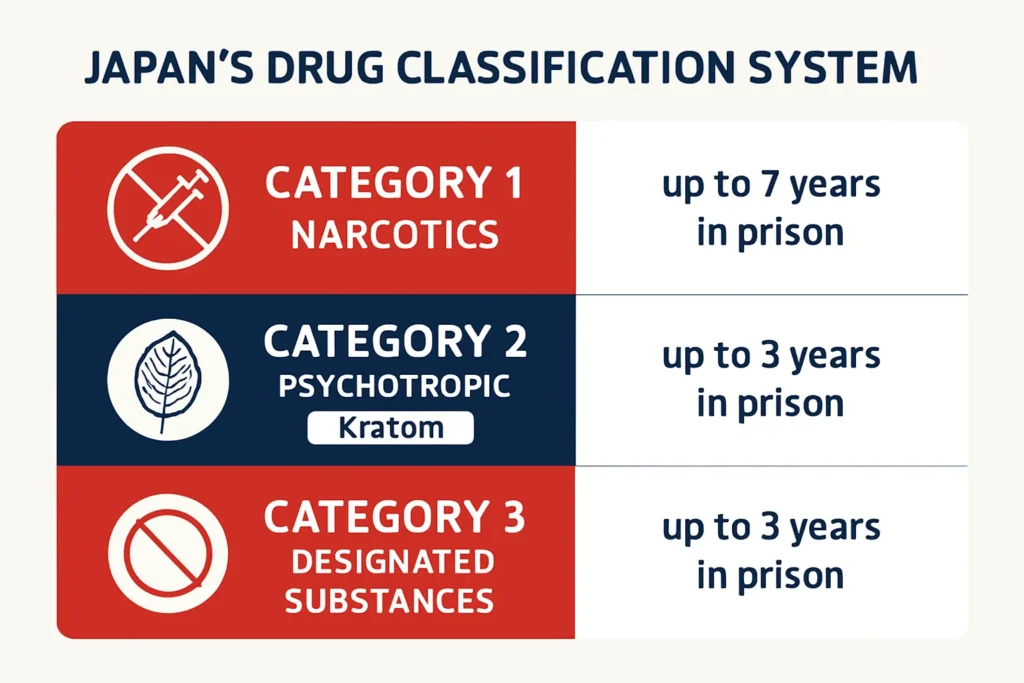
Japan employs a comprehensive classification system for controlled substances:
Category 1: Narcotics
- Traditional illegal drugs like cocaine and heroin
- Severe penalties for possession and distribution
Category 2: Psychotropic Substances
- Includes synthetic drugs and designer substances
- Kratom alkaloids fall under this category
Category 3: Designated Substances
- Emerging substances under investigation
- Can be quickly reclassified to higher categories
Specific Laws Governing Kratom
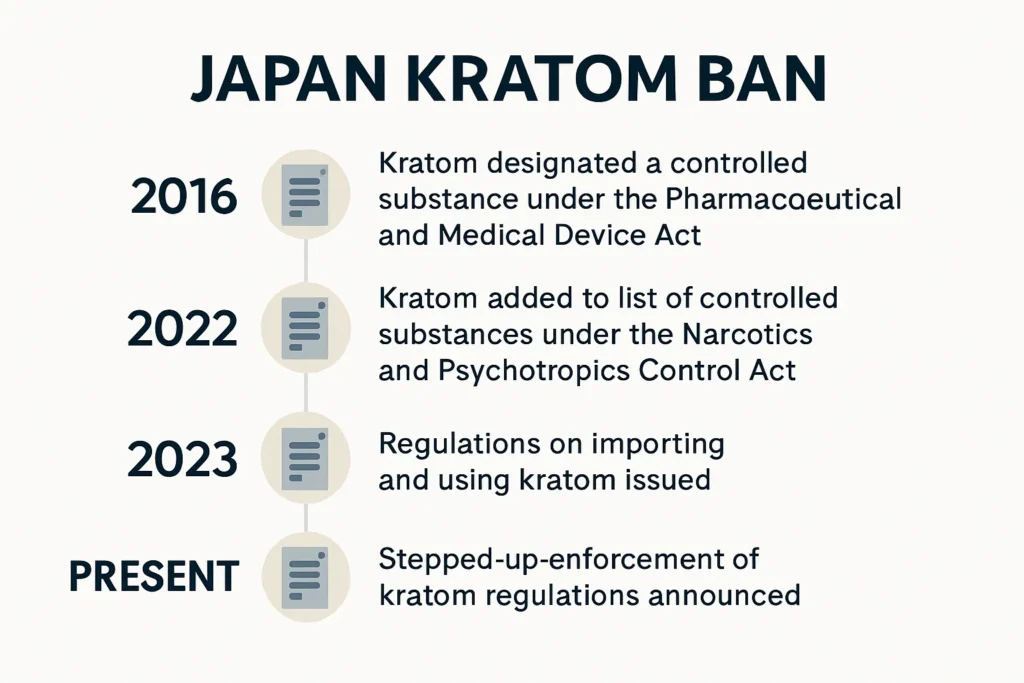
The 2016 Kratom Ban
Japan officially banned kratom in 2016 by designating its primary alkaloids, mitragynine and 7-hydroxymitragynine, as controlled substances. This decision followed reports of kratom-related incidents and aligned with Japan’s proactive approach to emerging psychoactive substances.
The ban specifically targets:
- Raw kratom leaves and powder
- Kratom extracts and concentrates
- Products containing kratom alkaloids
- Synthetic versions of kratom compounds
Legal Definitions
Under Japanese law, kratom is defined by the presence of its active alkaloids rather than just the plant material. This comprehensive definition means that:
- Any concentration of mitragynine or 7-hydroxymitragynine is illegal
- Trace amounts in other products can still result in charges
- Synthetic alternatives are also prohibited
- Derivative products fall under the same restrictions
Penalties and Enforcement
Criminal Penalties
Japan’s penalties for kratom violations are severe and consistently enforced:
Possession Charges:
- Up to 5 years imprisonment
- Fines up to 5 million yen (approximately $37,000 USD)
- Permanent criminal record
Distribution/Sale Charges:
- Up to 10 years imprisonment
- Fines up to 30 million yen (approximately $225,000 USD)
- Asset forfeiture possible
Importation Charges:
- Up to 20 years imprisonment
- Unlimited fines at court discretion
- Immediate deportation for foreign nationals
Enforcement Practices
Japanese authorities maintain strict enforcement protocols:
Customs Screening:
- Advanced detection equipment at all ports of entry
- Trained drug detection dogs
- Random package inspections
- International cooperation with origin countries
Domestic Enforcement:
- Regular online marketplace monitoring
- Undercover operations targeting sellers
- Coordination between prefectural and national police
- Zero tolerance policy implementation
International Travel Considerations
Airport and Border Controls
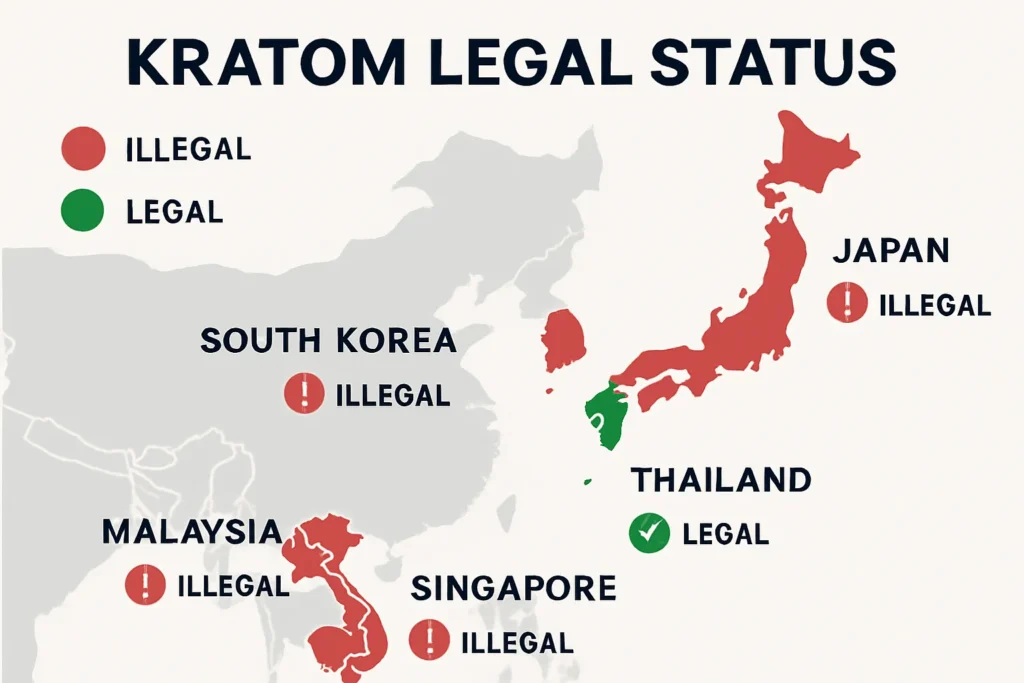
Japan’s customs and immigration services are particularly vigilant about controlled substances. Travelers should be aware that:
Pre-Arrival Screening:
- Passenger manifests are checked against watch lists
- Luggage screening includes chemical detection
- Personal items undergo thorough inspection
Documentation Requirements:
- No prescription or medical documentation can legalize kratom
- Previous kratom use in legal countries is irrelevant
- Ignorance of Japanese law is not a defense
Transit Passengers
Even passengers in transit through Japanese airports without entering the country can face prosecution if kratom is discovered in their luggage. Japan’s strict interpretation of territorial jurisdiction means that possession within airport boundaries constitutes a crime.
Comparison with Regional Laws
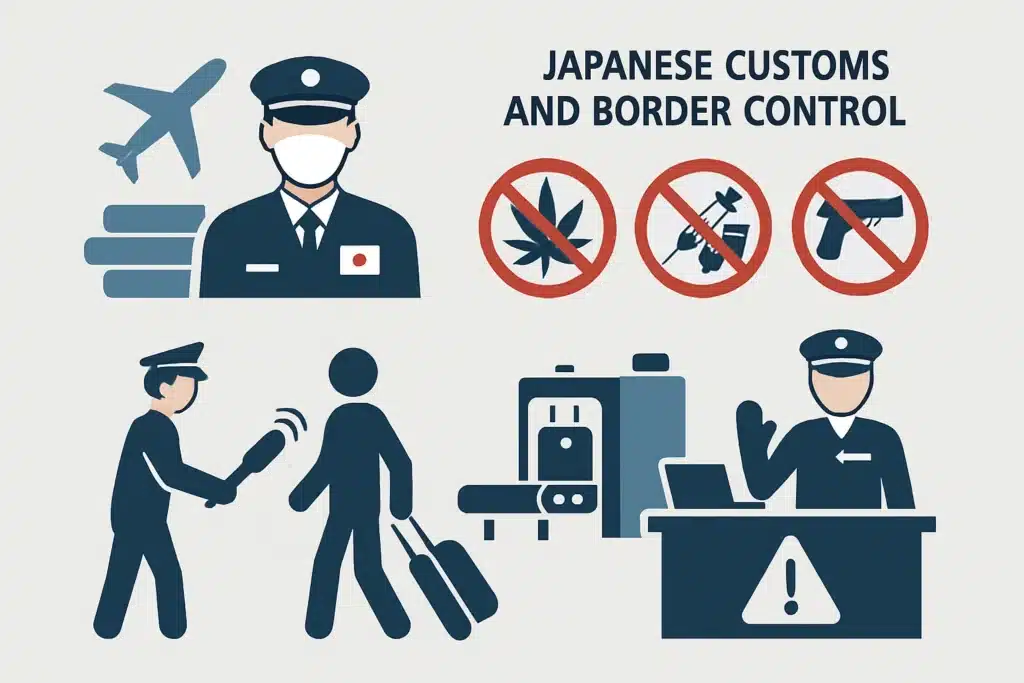
Understanding how Japan’s kratom laws compare to neighboring countries provides important context:
| Country | Legal Status | Penalties |
|---|---|---|
| Japan | Completely Illegal | Up to 20 years prison |
| South Korea | Illegal | Up to 10 years prison |
| China | Illegal | Severe criminal penalties |
| Thailand | Legal (as of 2021) | Previously illegal |
| Malaysia | Illegal | Death penalty possible |
| Singapore | Illegal | Death penalty possible |
This comparison highlights Japan’s position within a region where kratom laws vary dramatically. Unlike kratom’s legal status in California, where the substance remains legal under state law, Japan maintains absolute prohibition.
Medical and Research Perspectives
Scientific Research Restrictions
Japan’s ban on kratom extends to scientific research, creating significant barriers for academic study. Unlike countries where kratom research continues under controlled conditions, Japanese researchers face legal obstacles in studying the substance.
Research Limitations:
- No approved clinical trials involving kratom
- Limited access to samples for analysis
- Restricted collaboration with international researchers
- Prohibition on importing samples for study
Medical Community Position
The Japanese medical community generally supports the government’s stance on kratom prohibition. Medical professionals cite concerns about:
- Lack of standardized dosing protocols
- Potential for abuse and dependence
- Unknown long-term health effects
- Interactions with other medications
Cultural and Social Factors
Japanese Society’s Approach to Drugs
Japan’s strict drug laws reflect deep cultural values emphasizing social harmony and collective responsibility. The concept of “meiwaku” (causing trouble for others) strongly influences public policy on substances that might affect individual behavior or social order.
Cultural Considerations:
- Strong social stigma against drug use
- Emphasis on community well-being over individual choice
- Historical trauma from post-war drug problems
- Trust in government health recommendations
Public Opinion
Surveys indicate that the majority of Japanese citizens support strict drug laws, including the kratom ban. Public education campaigns have reinforced messages about the dangers of unregulated substances, contributing to widespread acceptance of prohibition policies.
Legal Alternatives and Options
Approved Pain Management
For individuals seeking alternatives to kratom for pain management or other health concerns, Japan offers various legal options:
Pharmaceutical Options:
- Prescription pain medications under medical supervision
- Traditional Japanese herbal medicines (Kampo)
- Physical therapy and rehabilitation services
- Acupuncture and other traditional treatments
Natural Supplements:
- Approved herbal supplements available in pharmacies
- Traditional remedies with established safety profiles
- Nutritional supplements for general wellness
- Mind-body practices like meditation and yoga
Consultation with Healthcare Providers
Visitors to Japan with chronic pain or other conditions should consult with qualified healthcare providers about legal treatment options. Many international medications are available through proper medical channels, though importation procedures must be followed carefully.
Practical Advice for Travelers
Before Traveling to Japan
Pre-Departure Checklist:
- Review all medications and supplements
- Consult with travel medicine specialists
- Obtain necessary medical documentation
- Research legal alternatives for any prohibited substances
Documentation Preparation:
- Carry prescriptions for all medications
- Translate medical documents into Japanese
- Contact Japanese embassy for guidance on specific medications
- Plan for potential medication shortages
While in Japan
Safe Practices:
- Only purchase medications from licensed pharmacies
- Avoid online purchases of unregulated substances
- Consult with local healthcare providers for medical needs
- Report any suspicious offers of illegal substances to authorities
Emergency Situations:
- Know location of nearest embassy or consulate
- Understand your rights if detained
- Have contact information for legal assistance
- Maintain communication with family or colleagues
Recent Developments and Updates
Law Enforcement Trends
Recent years have seen increased coordination between Japanese authorities and international partners in combating kratom trafficking. Notable developments include:
Enhanced Detection Methods:
- Improved chemical screening technology
- Better training for customs officials
- Increased cooperation with postal services
- Advanced data analytics for suspicious shipments
International Cooperation:
- Information sharing with source countries
- Joint operations with international law enforcement
- Coordination with shipping companies
- Enhanced intelligence gathering
Policy Discussions
While Japan maintains its strict stance on kratom, ongoing policy discussions focus on:
- Balancing public health concerns with individual rights
- Evaluating enforcement effectiveness
- Considering harm reduction approaches
- Monitoring international trends in drug policy
Business and Economic Implications
Impact on Tourism
Japan’s strict drug laws, including the kratom ban, have implications for the country’s tourism industry:
Visitor Education:
- Enhanced pre-arrival information campaigns
- Clear warnings about prohibited substances
- Coordination with travel agencies and tour operators
- Embassy outreach to potential visitors
Economic Considerations:
- Costs of enforcement and detention
- Impact on visitor confidence
- Administrative burden on customs services
- International reputation effects
Pharmaceutical Industry
The kratom ban affects Japan’s pharmaceutical industry in several ways:
Research Limitations:
- Restricted ability to study potential therapeutic applications
- Limited collaboration with international research institutions
- Reduced access to emerging botanical compounds
- Constraints on drug development programs
Market Protection:
- Protection of existing pharmaceutical markets
- Support for approved treatment modalities
- Emphasis on regulated drug development
- Maintenance of quality control standards
Support and Resources
Legal Assistance
Individuals facing kratom-related charges in Japan should immediately seek qualified legal representation:
Legal Resources:
- Japan Federation of Bar Associations
- Embassy or consulate legal assistance programs
- International law firms with Japanese practice
- Pro bono legal aid organizations
Important Considerations:
- Japanese legal proceedings differ significantly from Western systems
- Language barriers can complicate legal defense
- Early intervention is crucial for best outcomes
- Understanding of local legal culture is essential
Health Support
For those struggling with substance use issues, Japan offers various support services:
Treatment Options:
- Addiction treatment centers
- Mental health counseling services
- Support groups and peer programs
- Medical detoxification services
Prevention Programs:
- Educational outreach initiatives
- Community-based prevention efforts
- School and workplace education
- Public awareness campaigns
Frequently Asked Questions – Is Kratom Legal in Japan
Is kratom legal in Japan?
Kratom is illegal in Japan. The Japanese government classifies kratom and its active compounds as controlled substances. Possession, sale, import, or distribution is prohibited. This applies regardless of form, including powder, capsules, extracts, or raw leaves.
Why is kratom banned in Japan?
Japan restricts kratom due to concerns about its psychoactive alkaloids and potential health risks. Authorities aim to prevent misuse and unregulated distribution. The ban aligns with Japan’s strict drug control framework, which prioritizes public safety and precaution.
When did Japan make kratom illegal?
Japan officially banned kratom in 2014. The decision followed increased international attention on kratom and its effects. After the ban, kratom was added to Japan’s list of designated substances, making enforcement clear and consistent nationwide.
Is kratom considered a narcotic in Japan?
Kratom is not classified as a traditional narcotic in Japan, but it is regulated under designated substance laws. This status still makes it illegal. The legal outcome is similar, since penalties can apply for possession or handling.
Can tourists bring kratom into Japan?
Tourists are not allowed to bring kratom into Japan. Customs enforcement applies to visitors and residents alike. This includes small personal amounts.
- Kratom powder and capsules are prohibited
- Extracts and liquids are also banned
- Declaration does not make it legal
- Confiscation and penalties may occur
What happens if someone is caught with kratom in Japan?
Consequences depend on the situation and quantity involved.
- Confiscation of the substance
- Questioning by authorities
- Possible fines or detention
- Stricter outcomes for distribution cases
Is kratom legal for research purposes in Japan?
Kratom is generally not permitted for private research. Limited use may be allowed only with explicit government approval. Such permissions are rare and tightly controlled, usually restricted to licensed institutions operating under strict regulations.
Are kratom seeds or plants legal in Japan?
Kratom seeds and live plants are also illegal. Japan’s regulations cover the kratom plant itself, not only processed products.
- Seeds are prohibited for import
- Growing kratom domestically is not allowed
- Online orders can be seized at customs
Can kratom be sold online to customers in Japan?
Selling kratom to customers in Japan is illegal, even if the seller is based overseas. Japanese customs actively monitor shipments. Online listings that target Japanese buyers can result in enforcement actions.
Is kratom legal in other parts of Asia?
Kratom laws vary widely across Asia.
- Legal or partially legal in some Southeast Asian countries
- Restricted or banned in others, including Japan
- Laws often change and differ by country
Should travelers check kratom laws before visiting Japan?
Yes. Travelers should always review local substance laws before arrival. Japan enforces drug regulations strictly. Items that are legal elsewhere may be illegal in Japan, including kratom and related products.
Conclusion
Japan maintains an absolute prohibition on kratom, with severe criminal penalties for any involvement with the substance. The country’s comprehensive ban covers possession, distribution, importation, and manufacturing, with no exceptions for medical use or personal consumption. Understanding these laws is crucial for anyone traveling to or residing in Japan.
The penalties for kratom violations in Japan are among the world’s strictest, reflecting the country’s zero-tolerance approach to controlled substances. Prison sentences can extend up to 20 years for importation offenses, while fines can reach millions of yen. Foreign nationals face additional consequences including immediate deportation and permanent entry bans.
For those seeking alternatives to kratom for health concerns, Japan offers various legal options through its regulated healthcare system. Consulting with qualified medical professionals and following proper importation procedures for approved medications is essential for maintaining legal compliance.
The enforcement of Japan’s kratom laws is thorough and consistent, with advanced detection methods at all points of entry and ongoing domestic surveillance. International cooperation with law enforcement agencies worldwide has made trafficking attempts increasingly risky and unsuccessful.
As Japan continues to monitor emerging psychoactive substances, the kratom ban represents the country’s proactive approach to drug control. While kratom remains legal in many parts of the United States and other countries, Japan’s position is unlikely to change in the foreseeable future.
Daniel Brooks
Daniel Brooks is a U.S. based botanical writer with over six years of hands on experience in kratom focused content. He studies kratom strains, sourcing standards, dosage patterns, and consumer safety topics. He stays up to date with current news, regulatory changes, and market trends related to kratom and botanical products.
His work includes educational guides, strain breakdowns, and vendor reviews written for everyday users. He avoids promotional language and presents clear facts. Daniel helps readers understand both benefits and risks so they can make informed choices about responsible kratom use.