

Kratom stays in your body longer than you think. Most users don’t realize detection windows stretch days or weeks. Understanding how long is kratom in your system matters for employment screening, medical testing, and safe usage planning. The answer depends on dose, frequency, and testing method.
- Mitragynine has a 24-hour half-life – your body eliminates half the alkaloids daily
- Urine tests detect kratom for 2-14 days depending on usage frequency
- Standard workplace drug tests don’t screen for kratom – detection requires specific testing
- Higher doses stay in your system longer – concentrated extracts take more time to clear
- Blood and saliva tests show 24-48 hour windows – hair tests extend to 90+ days
Understanding How Long Kratom Stays In Your System
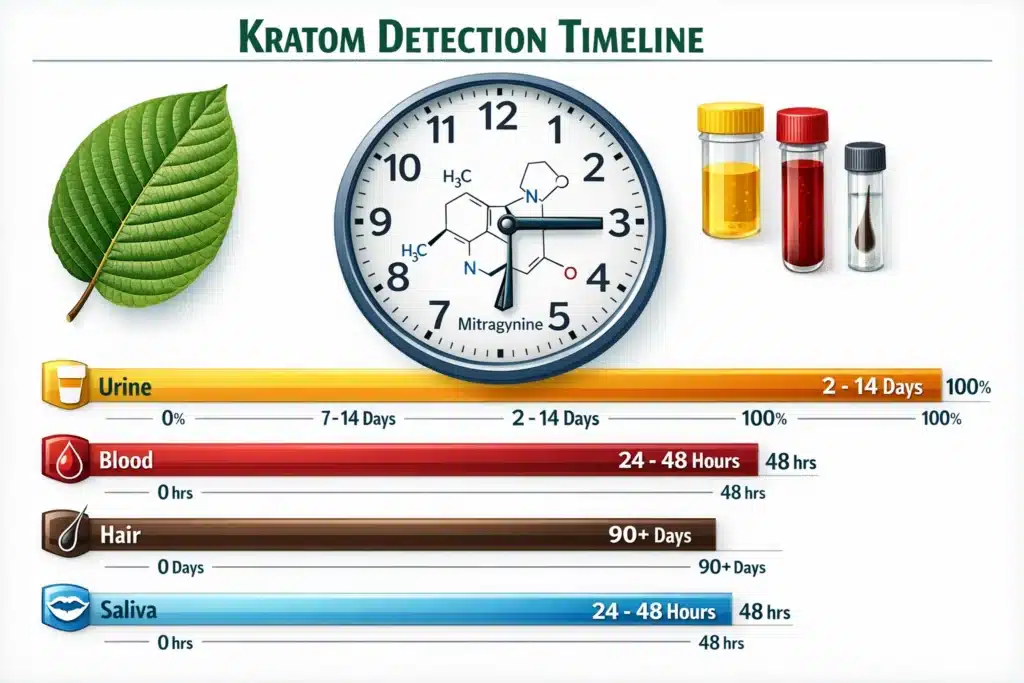
Kratom doesn’t disappear quickly. The primary alkaloid mitragynine has a half-life of 24 hours.[1][8] That means your body needs a full day to eliminate half the dose.
Half-life determines detection windows. After one day, 50% remains. After two days, 25% lingers. Complete elimination takes 5-6 half-lives.[1]
Most users clear kratom in 5-6 days for occasional use. Heavy users need 9-14 days for complete elimination.[1][2]
Factors That Affect Detection Time
Body fat percentage matters. Kratom alkaloids are fat-soluble. Higher body fat means longer storage.[4]
Hydration speeds elimination. Water intake affects kidney function. Better hydration means faster clearance through urine.
Food intake changes absorption. Taking kratom on an empty stomach works faster. But it also clears faster.[5]
Age slows everything down. Metabolism decreases after 30. Older users retain kratom longer.[4]
Detection Windows: How Long Is Kratom In Your System For Different Tests
Testing method determines detection window. Each test type has different timeframes. Understanding these windows helps you plan accordingly.
Urine Testing: The Most Common Method
Urine tests detect kratom longest. Occasional users show positive for 2-5 days.[2][4][9] Heavy users test positive for 9-14 days.[1][2][4]
Labs use sensitive cutoffs. Labcorp screens at 5 ng/mL. Confirmation tests detect as low as 1 ng/mL.[3] Even small amounts show up.
Urine detection windows depend on frequency:
| Usage Pattern | Detection Window | Alkaloid Concentration |
|---|---|---|
| Single use | 2-5 days | Low |
| Weekly use | 5-7 days | Moderate |
| Daily use | 7-9 days | High |
| Heavy daily use | 9-14 days | Very high |
Most employment screening doesn’t test for kratom. Standard 5-panel, 10-panel, and 12-panel tests skip it entirely.[3]
Blood Testing: Short Detection Window
Blood tests show kratom for 24-48 hours only.[2][4][5] This method confirms very recent use.
Blood testing is expensive. Most employers skip it. Medical facilities use it for acute situations.
The short window makes blood tests impractical. They miss use from 2-3 days prior.
Saliva Testing: Emerging Method
Saliva tests detect kratom for 24-48 hours.[2][3] Oral fluid LC-MS/MS technology captures parent compounds shortly after ingestion.
Saliva testing is convenient. Non-invasive collection works anywhere. Results come faster than urine.
This method works best for relapse monitoring. It shows very recent intake clearly.[2]
🕐 Kratom Detection Timeline Calculator
Your Estimated Detection Windows
Dosage Impact: How Much You Take Matters
Kratom Dosage size directly affects elimination time. Higher doses take longer to clear. Understanding kratom effects and duration helps you plan better.
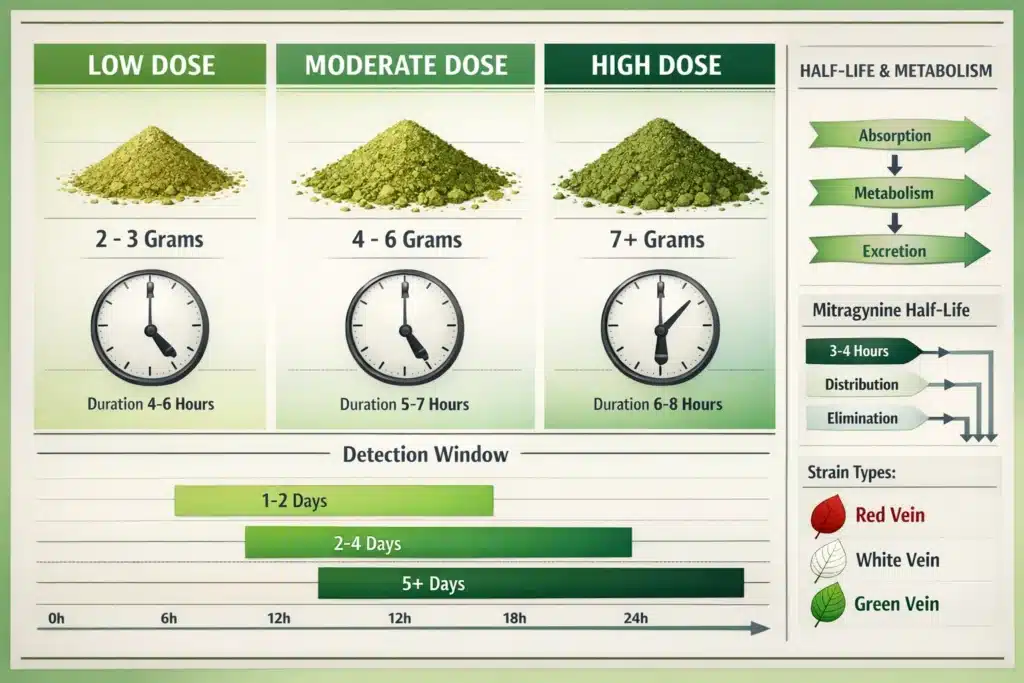
Low Dose (2-3 Grams)
Low doses clear fastest. Most users eliminate these amounts in 2-4 days.[4] Effects last 4-6 hours.
Start with low doses. New users should begin here. It’s safer and clears quicker.
Detection windows shrink with smaller amounts. Single low-dose use rarely shows after 5 days.
Moderate Dose (4-6 Grams)
Moderate doses extend detection to 5-7 days.[4] Effects last 5-7 hours. Most users prefer this range.
Quality varies between vendors. Alkaloid content changes elimination time. Higher quality means stronger effects and longer detection.
This dose range balances effects with clearance time. It works for most regular users.
High Dose (7+ Grams)
High doses stay longest. Detection extends to 7-14 days for regular users.[1][2] Effects last 6-8 hours or more.
Avoid high doses without tolerance. Side effects increase significantly. Elimination time doubles compared to low doses.
Concentrated extracts take even longer. Enhanced products contain more 7-hydroxymitragynine. Despite shorter half-life, total alkaloid load extends detection.[1]
Frequency and Usage Patterns
How often you use kratom matters more than dose. Daily use creates accumulation. Occasional use clears much faster.
Single-Use or Occasional Users
One-time users clear kratom in 2-5 days.[2][4][9] The body processes it efficiently without buildup.
Occasional use means less than weekly. These users show the shortest detection windows. Most clear completely within a week.
Testing positive after 7 days is rare for single use. Only extremely sensitive tests catch it.
Regular Users (2-3 Times Weekly)
Regular users need 5-9 days for clearance.[4] Alkaloids accumulate slightly between doses.
Consistency matters. Taking kratom every 3-4 days creates minor buildup. Detection windows extend compared to single use.
This pattern shows moderate risk for testing. Plan 10 days minimum for complete clearance.
Daily and Heavy Users
Daily users face 9-14 day detection windows.[1][2][4] Heavy use creates significant alkaloid accumulation.
Daily use changes metabolism. Your body adapts to regular intake. Elimination slows as alkaloids build in fat tissue.
Kratom withdrawal can occur with heavy use. Stopping suddenly causes discomfort for some users.
Multiple daily doses extend detection even further. Some heavy users test positive beyond 14 days.
Frequently Asked Questions
How long does kratom stay in your system?
Kratom can remain in the body for several days, depending on multiple factors. Most research suggests that kratom compounds may be detectable for about one to three days. In some cases, traces may last longer due to metabolism speed, frequency of use, and individual body chemistry.
What factors affect how long kratom stays in your system?
Several variables influence how long kratom remains detectable. These factors interact and can shorten or extend how long it stays in your system.
- Amount and frequency of use
- Body weight and metabolism
- Hydration and diet
- Overall health and liver function
How long is kratom detectable in urine?
Urine testing is the most common method used to detect kratom. In general, kratom alkaloids may be detectable in urine for one to three days after use. Heavy or repeated use may extend this window, while occasional use may result in shorter detection times.
Does kratom show up on a standard drug test?
Kratom does not usually appear on standard five panel or ten panel drug tests. It requires a specific test designed to detect kratom alkaloids. Results depend on the type of test used, the timing of use, and the sensitivity of the testing method.
How long does kratom stay in your blood?
Kratom is typically detectable in blood for a shorter time than in urine. Blood tests may identify kratom compounds for up to twenty four hours after use. This timeframe can vary based on dosage, frequency, and how quickly the body processes the active compounds.
Can kratom be detected in hair tests?
Hair testing can detect substances over a longer period, though kratom hair testing is less common. When used, it may identify kratom use weeks after consumption.
- Hair tests reflect long term exposure
- Detection may extend up to ninety days
- Results depend on hair growth rate
Does dosage change how long kratom stays in your system?
Yes, dosage plays a role in how long kratom remains in the body. Higher or more frequent doses may take longer to fully clear. Smaller or occasional doses often leave the system more quickly, though individual metabolism and health factors still influence the overall timeline.
Can hydration or diet affect kratom elimination?
Hydration and diet may influence how efficiently the body processes and eliminates kratom. While they do not guarantee faster removal, they can support normal metabolic function.
- Adequate water intake supports kidney function
- Balanced meals aid metabolism
- Poor hydration may slow elimination
Conclusion: Planning Around Detection Windows
How long is kratom in your system? The answer ranges from 2 days to 14 days for urine testing. Blood and saliva show 24-48 hours. Hair testing extends to 90+ days.
Your usage pattern matters most. Single-use clears in 2-5 days. Daily use needs 9-14 days minimum.[1][2][4]
Most workplace tests don’t screen for kratom. Standard panels miss it entirely.[3] But specialized testing exists when employers specifically request it.
References
[1] How Long Does Kratom Stay In Your System – https://refinerecovery.com/how-long-does-kratom-stay-in-your-system/
[2] How Long Does Kratom Stay In Your System – https://hcana.com/blog/how-long-does-kratom-stay-in-your-system/
[3] Does Kratom Show Up On Drug Test – https://thoroughbredbhc.com/blog/does-kratom-show-up-on-drug-test/
[4] How Long Does Kratom Stay In Your System – https://alpaswellnesscenters.org/how-long-does-kratom-stay-in-your-system/
[5] How Long Does Kratom Stay In Your System – https://monroestreetsoberliving.com/how-long-does-kratom-stay-in-your-system/
[8] How Long Does Kratom Stay In Your System – https://recovered.org/other/kratom/how-long-does-kratom-stay-in-your-system
[9] How Long Does Kratom Stay In Your System – https://illinoisrecoverycenter.com/how-long-does-kratom-stay-in-your-system/
Daniel Brooks
Daniel Brooks is a U.S. based botanical writer with over six years of hands on experience in kratom focused content. He studies kratom strains, sourcing standards, dosage patterns, and consumer safety topics. He stays up to date with current news, regulatory changes, and market trends related to kratom and botanical products.
His work includes educational guides, strain breakdowns, and vendor reviews written for everyday users. He avoids promotional language and presents clear facts. Daniel helps readers understand both benefits and risks so they can make informed choices about responsible kratom use.
Ryan Mitchell
Ryan Mitchell reviews and approves all kratom and botanical content before it is published. He has worked in the botanical space since 2013 and has been closely involved in kratom education, sourcing standards, and product evaluation.
Ryan actively supports responsible kratom use and spends time engaging with user communities where botanicals are discussed in detail. He has guided tens of thousands of customers through product selection and usage questions over the years. He works directly with trusted growers and suppliers to verify quality. He also ensures third party lab testing is completed so products meet safety and purity expectations before reaching the public.