How Long Does Kratom Stay In Your System

How Long Does Kratom Stay In Your System: Complete Detection Guide

When law enforcement officers in Thailand discovered kratom leaves in a suspect’s possession, they faced an unexpected challenge: determining when the person had actually consumed the botanical substance. This issue is increasingly relevant in the United States as kratom’s popularity grows. Many users now ask, “How long does kratom stay in your system,” as they want to understand detection times and how long kratom metabolites remain in the body.

  • Kratom typically stays detectable in urine for 5-7 days after last use, though this can extend to 9 days for heavy users
  • Blood tests can detect kratom for 1-3 days, making them suitable for recent use detection
  • Hair follicle tests may show kratom use for up to 90 days, though specialized testing is required
  • Detection times vary significantly based on dosage, frequency of use, metabolism, and individual factors
  • Standard drug tests don’t typically screen for kratom, requiring specialized testing methods

What Is Kratom and How Does It Work?

Kratom (Mitragyna speciosa) is a tropical tree native to Southeast Asia, where its leaves have been traditionally used for centuries. The plant contains over 40 alkaloids, with mitragynine and 7-hydroxymitragynine being the primary active compounds responsible for kratom’s effects.

When consumed, these alkaloids interact with opioid receptors in the brain, producing effects that can range from stimulation at lower doses to sedation at higher amounts. This unique alkaloid profile sets kratom apart from other substances and directly impacts how long it remains detectable in the body.

Primary Kratom Alkaloids:

  • Mitragynine: The most abundant alkaloid (up to 66% of total alkaloid content)
  • 7-hydroxymitragynine: More potent but less abundant (up to 2% of total content)
  • Speciogynine: Secondary alkaloid affecting duration
  • Paynantheine: Contributes to muscle relaxant properties

The body processes these alkaloids through the liver’s cytochrome P450 enzyme system, primarily CYP3A4 and CYP2D6, before eliminating them through urine and feces.

How Long Does Kratom Stay In Your System: Detection Timeline

The duration kratom remains in your system depends on several biological and external factors. Understanding these timeframes helps users make informed decisions about consumption and potential testing scenarios.

Kratom Half-Life

Kratom’s half-life ranges from 3.85 to 9.43 hours for mitragynine, with an average of approximately 7 hours. The half-life represents the time needed for your body to eliminate half of the substance from your bloodstream.

7-hydroxymitragynine has a slightly different elimination profile, with studies suggesting a half-life of 2.5 to 6 hours. This variance occurs because different alkaloids are metabolized at different rates.

Complete Elimination Timeline

Based on the half-life principle, kratom alkaloids are generally eliminated from the system within 5-6 elimination cycles:

TimeframePercentage EliminatedRemaining in System
7 hours (1 half-life)50%50%
14 hours (2 half-lives)75%25%
21 hours (3 half-lives)87.5%12.5%
28 hours (4 half-lives)93.75%6.25%
35 hours (5 half-lives)96.875%3.125%

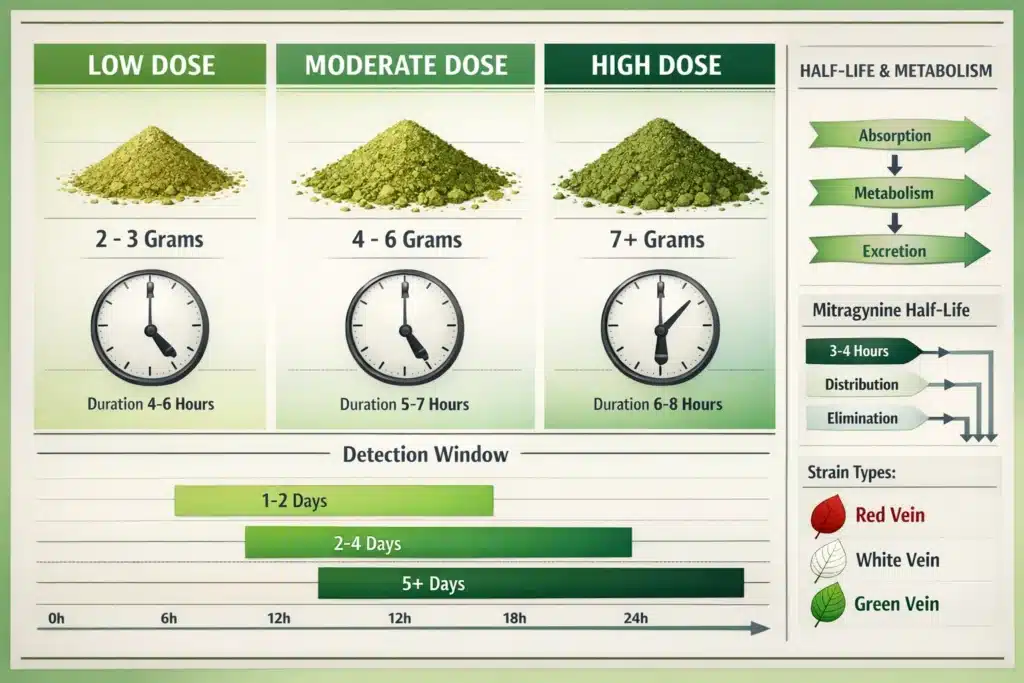
Most kratom alkaloids are eliminated within 24-48 hours of last use, though metabolites may remain detectable longer depending on the testing method.

Kratom Detection Methods and Windows

Kratom Detection Methods and Windows

Different testing methods offer varying detection windows and sensitivity levels. Understanding these differences is crucial for anyone concerned about kratom detection.

Urine Testing

Urine tests are the most common method for kratom detection due to their non-invasive nature and reasonable detection window.

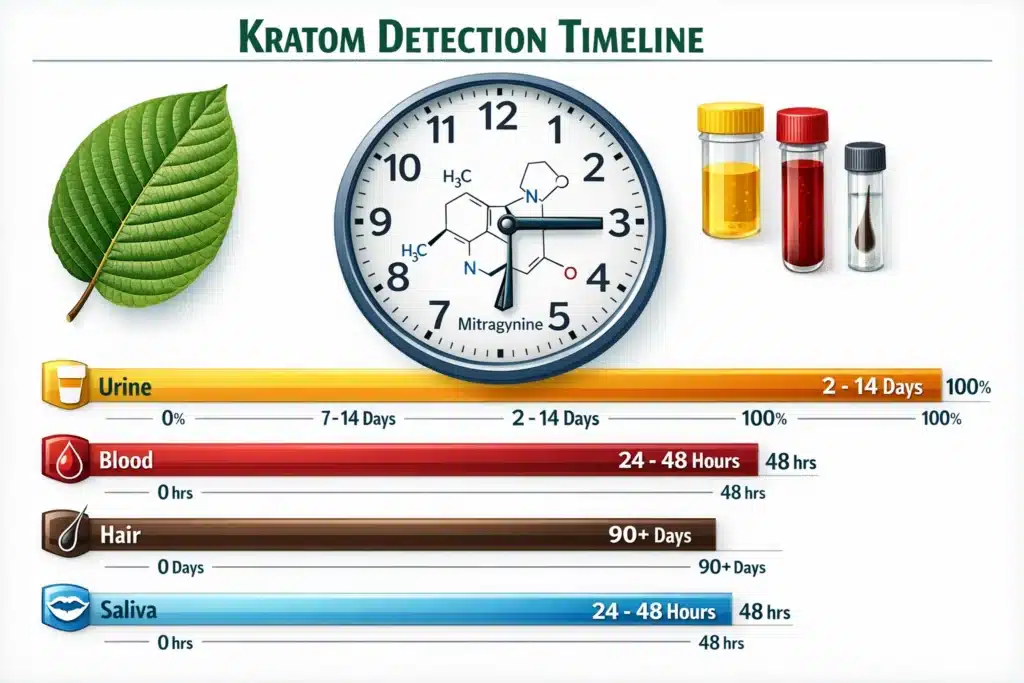
Detection Window: 5-7 days (up to 9 days for heavy users)

Urine testing detects kratom metabolites rather than the original alkaloids. The primary metabolites include:

  • Mitragynine glucuronide
  • 7-hydroxymitragynine glucuronide
  • Various oxidative metabolites

Factors affecting urine detection:

  • Hydration levels
  • Kidney function
  • Urine pH (alkaline urine may extend detection)
  • Frequency of urination

Blood Testing

Blood tests provide the shortest detection window but offer the most accurate picture of recent kratom use.

Detection Window: 1-3 days

Blood testing directly measures active alkaloids in the bloodstream, making it ideal for determining recent consumption or impairment. However, the narrow detection window limits its usefulness for detecting past use.

Advantages of blood testing:

  • High accuracy for recent use
  • Can indicate active impairment
  • Difficult to adulterate

Disadvantages:

  • Invasive collection method
  • Short detection window
  • More expensive than urine testing

Hair Follicle Testing

Hair follicle tests offer the longest detection window but require specialized laboratory equipment and expertise.

Detection Window: Up to 90 days

Hair testing works by detecting drug metabolites that become incorporated into the hair shaft as it grows. Since hair grows approximately 0.5 inches per month, a standard 1.5-inch sample can detect use over the previous three months.

Important considerations for hair testing:

  • Requires specialized kratom-specific testing
  • May not detect very recent use (last 7-10 days)
  • Can be affected by hair treatments and environmental exposure
  • More expensive and less commonly available

Saliva Testing

Saliva testing for kratom is less common but may be used in specific circumstances.

Detection Window: 1-2 days

Saliva tests detect recent kratom use and are non-invasive, making them suitable for roadside testing or workplace screening. However, the detection window is relatively short, and specialized testing is required.

Factors Affecting How Long Kratom Stays In Your System
Multiple variables influence kratom’s elimination timeline, creating significant individual variation in detection windows.

Dosage and Frequency of Use

Higher doses and frequent use significantly extend detection times:

  • Occasional users (1-2 times per week): 3-5 days
  • Regular users (3-4 times per week): 5-7 days
  • Daily users: 7-9 days
  • Heavy daily users (multiple doses): Up to 10+ days

The body’s ability to process and eliminate kratom becomes overwhelmed with frequent use, leading to accumulation of alkaloids and metabolites.

Individual Metabolism

Metabolic rate plays a crucial role in kratom elimination:

Fast metabolism:

  • Younger individuals (18-30 years)
  • Higher muscle mass
  • Active lifestyle
  • Efficient liver function

Slower metabolism:

  • Older individuals (50+ years)
  • Sedentary lifestyle
  • Liver dysfunction
  • Certain medications

Body Composition

Body fat percentage affects kratom storage and elimination:

  • Higher body fat: Longer detection times due to alkaloid storage in fatty tissue
  • Lower body fat: Faster elimination and shorter detection windows
  • Body weight: Heavier individuals may process kratom differently than lighter users

Liver Function

The liver’s cytochrome P450 enzyme system is responsible for kratom metabolism:

Factors affecting liver function:

  • Alcohol consumption
  • Prescription medications
  • Liver disease
  • Genetic variations in enzyme activity
  • Age-related decline

Individuals with compromised liver function may experience significantly extended detection times.

Hydration and Kidney Function

Kidney health and hydration status directly impact kratom elimination through urine:

  • Well-hydrated individuals: Faster elimination through increased urine production
  • Dehydrated individuals: Slower elimination and concentrated metabolites
  • Kidney dysfunction: Significantly extended detection times

pH Levels

Body pH affects kratom alkaloid stability and elimination:

  • Acidic urine (pH < 6.0): Faster elimination
  • Alkaline urine (pH > 7.0): Slower elimination and extended detection

Diet, medications, and health conditions can all influence body pH levels.

Kratom Detection Time Calculator

🧪 Kratom Detection Time Calculator

Get personalized estimates based on your usage patterns and individual factors

⚠️ Important Disclaimer: These estimates are based on general research and should not be considered medical advice. Actual detection times can vary significantly between individuals. Factors like genetics, medications, and health conditions can dramatically affect these timeframes. Always consult healthcare professionals for personalized guidance.

Drug Testing Policies and Kratom

Understanding current drug testing policies helps users navigate potential screening scenarios and make informed decisions about kratom use.

Standard Drug Panel Testing

Most standard drug tests do not include kratom screening:

5-Panel Drug Test (most common):

  • Marijuana (THC)
  • Cocaine
  • Amphetamines
  • Opiates
  • PCP

10-Panel Drug Test:

  • All 5-panel substances
  • Barbiturates
  • Benzodiazepines
  • Methadone
  • Propoxyphene
  • Quaaludes

12-Panel Drug Test:

  • All 10-panel substances
  • MDMA (Ecstasy)
  • Oxycodone

Specialized Kratom Testing

Kratom-specific testing requires specialized laboratory procedures and is significantly more expensive than standard panels. This testing is typically only conducted when:

  • Specific suspicion of kratom use exists
  • Legal proceedings require comprehensive substance screening
  • Research purposes
  • Specialized workplace policies specifically mention kratom

Employment Drug Testing

Workplace drug testing policies vary significantly:

Industries with higher likelihood of kratom testing:

  • Transportation (DOT-regulated)
  • Healthcare facilities
  • Law enforcement
  • Government positions
  • Safety-sensitive roles

Pre-employment vs. Random testing:

  • Pre-employment: May include expanded panels
  • Random testing: Usually limited to standard panels
  • For-cause testing: More likely to include specialized substances

Legal Considerations

The legal status of kratom affects testing policies and consequences. Understanding kratom’s legal status in your jurisdiction is essential, as laws vary by state and locality.

States with kratom restrictions may have different testing approaches:

Kratom Metabolism and Elimination Process

kratom elimination time

Understanding how the body processes kratom provides insight into detection timeframes and individual variation.

Absorption Phase

Oral consumption (most common method):

  • Onset: 10-25 minutes
  • Peak effects: 1-3 hours
  • Duration: 4-6 hours

Factors affecting absorption:

  • Stomach contents (food delays absorption)
  • Kratom form (powder vs. capsules vs. extracts)
  • Individual gastric pH
  • Gastrointestinal health

Distribution Phase

Once absorbed, kratom alkaloids distribute throughout the body:

Primary distribution sites:

  • Brain tissue: Where therapeutic effects occur
  • Liver: Primary metabolism site
  • Kidneys: Elimination pathway
  • Fatty tissues: Storage sites affecting elimination

Blood-brain barrier crossing:

  • Mitragynine crosses readily
  • 7-hydroxymitragynine has higher affinity
  • Distribution affects both effects and elimination

Metabolism Phase

Liver metabolism occurs through multiple pathways:

Phase I metabolism:

  • Cytochrome P450 enzymes (CYP3A4, CYP2D6)
  • Oxidation and hydroxylation reactions
  • Creates active and inactive metabolites

Phase II metabolism:

  • Glucuronidation (primary pathway)
  • Sulfation (secondary pathway)
  • Creates water-soluble compounds for elimination

Metabolic pathways:

  1. Mitragynine → Multiple hydroxylated metabolites
  2. 7-hydroxymitragynine → Glucuronide conjugates
  3. Secondary alkaloids → Various oxidative products

Elimination Phase

Primary elimination routes:

Urine (60-70%):

  • Glucuronide conjugates
  • Unchanged alkaloids (small amount)
  • Oxidative metabolites

Feces (20-30%):

  • Unabsorbed kratom
  • Biliary excretion products
  • Metabolites from enterohepatic circulation

Other routes (10%):

  • Breath (minimal)
  • Sweat (trace amounts)
  • Saliva (temporary presence)

Factors That May Speed Up Kratom Elimination

Several strategies may help accelerate kratom elimination, though individual results vary significantly.

Hydration Optimization

Proper hydration supports kidney function and elimination:

Recommended approach:

  • Drink 8-10 glasses of water daily
  • Include electrolyte-rich beverages
  • Avoid excessive water intake (can be dangerous)
  • Monitor urine color (pale yellow indicates good hydration)

Hydration benefits:

  • Increased urine production
  • Improved kidney filtration
  • Enhanced metabolite elimination
  • Better overall health support

Exercise and Physical Activity

Regular exercise may accelerate elimination through multiple mechanisms:

Cardiovascular exercise:

  • Improves circulation
  • Enhances liver blood flow
  • Increases metabolic rate
  • Promotes sweating (minor elimination route)

Strength training:

  • Builds muscle mass
  • Increases metabolic rate
  • Improves overall health
  • Supports liver function

Exercise considerations:

  • Start gradually if sedentary
  • Stay hydrated during workouts
  • Avoid extreme exercise programs
  • Listen to your body’s limits

Nutritional Support

Dietary choices can support the body’s natural elimination processes:

Liver-supporting foods:

  • Cruciferous vegetables: Broccoli, cauliflower, Brussels sprouts
  • Antioxidant-rich fruits: Berries, citrus fruits
  • Lean proteins: Support liver enzyme production
  • Healthy fats: Omega-3 fatty acids

Foods to avoid:

  • Excessive alcohol (impairs liver function)
  • High-sugar processed foods
  • Trans fats and fried foods
  • Excessive caffeine

Sleep and Recovery

Quality sleep supports metabolic processes and elimination:

Sleep benefits:

  • Liver regeneration occurs during deep sleep
  • Hormone regulation affects metabolism
  • Improved immune function
  • Better stress management

Sleep optimization:

  • Aim for 7-9 hours nightly
  • Maintain consistent sleep schedule
  • Create dark, cool sleeping environment
  • Limit screen time before bed

Stress Management

Chronic stress can impair elimination processes:

Stress reduction techniques:

  • Meditation and mindfulness
  • Deep breathing exercises
  • Regular physical activity
  • Social support systems

Stress impacts on elimination:

  • Affects liver enzyme activity
  • Alters hormone levels
  • Impacts sleep quality
  • Influences dietary choices

Common Myths About Kratom Detection

Separating fact from fiction helps users make informed decisions based on accurate information.

Myth 1: “Drinking lots of water will flush kratom immediately”

Reality: While hydration supports elimination, excessive water consumption:

  • Cannot significantly accelerate the natural elimination process
  • May dilute urine samples (flagged by testing facilities)
  • Can be dangerous in extreme amounts (water intoxication)
  • Does not affect the fundamental half-life of kratom alkaloids

Proper hydration supports natural elimination but cannot override biological processes.

Myth 2: “Kratom doesn’t show up on any drug tests”

Reality: While kratom is not included in standard drug panels, specialized testing can detect it:

  • Dedicated kratom tests are available
  • Some expanded panels may include kratom screening
  • Testing technology continues to improve
  • Legal and workplace policies may specifically require kratom testing

Myth 3: “Detox products can eliminate kratom faster”

Reality: Most commercial detox products have limited scientific evidence:

  • No product can significantly alter kratom’s half-life
  • Many products are expensive and unregulated
  • Some may contain harmful ingredients
  • Natural elimination is generally the most effective approach

Focus on supporting natural processes rather than relying on unproven products.

Myth 4: “Exercise immediately before a test helps”

Reality: Acute exercise before testing may actually be counterproductive:

  • Can temporarily increase metabolite concentration in blood
  • May cause dehydration affecting test results
  • Cannot meaningfully impact detection windows
  • Consistent exercise over time is more beneficial

Myth 5: “Certain kratom strains don’t show up on tests”

Reality: All kratom varieties contain detectable alkaloids:

  • Different strains have varying alkaloid profiles
  • Testing methods detect common kratom metabolites
  • Red strains, enhanced varieties, and brown kratom all contain mitragynine
  • Strain differences don’t significantly affect detectability

Kratom vs. Other Substances: Detection Comparison

kratom detection window

Understanding how kratom detection compares to other substances provides useful context for users.

Detection Window Comparison

SubstanceUrine DetectionBlood DetectionHair Detection
Kratom5-7 days1-3 daysUp to 90 days
Marijuana3-30 days1-2 daysUp to 90 days
Cocaine1-3 days12-24 hoursUp to 90 days
Opiates1-3 days6-24 hoursUp to 90 days
Alcohol12-24 hours12-24 hoursUp to 90 days
Amphetamines1-3 days12 hoursUp to 90 days

Testing Frequency

Kratom testing is significantly less common than screening for traditional substances:

  • Standard panels: Include common substances but rarely kratom
  • Cost considerations: Kratom testing is more expensive
  • Legal factors: Kratom’s legal status affects testing priorities
  • Detection difficulty: Requires specialized laboratory capabilities

Workplace Implications

Employment consequences vary by substance and company policy:

  • Traditional drugs: Well-established policies and consequences
  • Kratom: Policies vary widely and are often unclear
  • Legal substances: May still result in workplace action
  • Safety-sensitive positions: More stringent testing requirements

Legal and Medical Considerations

Understanding the broader context of kratom detection involves legal and medical factors that affect users.

Current Legal Status

Federal level: Kratom remains federally legal but faces ongoing scrutiny:

  • DEA has considered scheduling but hasn’t acted
  • FDA continues to issue warnings about kratom
  • Congressional interest in regulation continues
  • Legal status could change rapidly

State and local laws vary significantly:

  • Some states have banned kratom entirely
  • Others have age restrictions or labeling requirements
  • Local municipalities may have their own ordinances
  • Legal guidance helps users stay informed

Medical Interactions

Healthcare providers should be informed about kratom use:

Potential medication interactions:

  • Blood thinners (warfarin)
  • Seizure medications
  • Heart medications
  • Psychiatric medications

Medical testing considerations:

  • May affect certain blood tests
  • Could interact with anesthesia
  • Important for emergency medical care
  • Relevant for surgical procedures

Workplace Rights

Employee rights regarding kratom testing vary:

At-will employment: Most employees can be terminated for any legal reason
Union protections: Collective bargaining agreements may offer protections
Medical marijuana laws: Don’t typically extend to kratom
Disability accommodations: Limited legal precedent for kratom use

Tips for Kratom Users Facing Drug Tests

Practical advice for individuals who use kratom and may face drug testing scenarios.

Pre-Employment Screening

Before applying for positions:

  1. Research company policies: Look for specific mentions of kratom
  2. Understand industry standards: Some sectors test more comprehensively
  3. Timeline planning: Allow adequate time for elimination if needed
  4. Legal consultation: Consider speaking with employment attorneys
  5. Alternative opportunities: Focus on employers with kratom-friendly policies

Random Workplace Testing

For current employees:

  1. Know your company policy: Understand what substances are tested
  2. Understand testing methods: Learn about your workplace’s testing procedures
  3. Legal protections: Research your state’s employment laws
  4. Documentation: Keep records of kratom use and any medical recommendations
  5. Professional guidance: Consider consulting with HR or legal professionals

Legal Proceedings

Court-ordered testing may be more comprehensive:

  1. Legal representation: Always work with qualified attorneys
  2. Testing disclosure: Understand what substances will be tested
  3. Medical documentation: Gather any relevant medical records
  4. Compliance importance: Follow all court orders precisely
  5. Professional monitoring: Work with legal professionals throughout the process

Medical Situations

Healthcare-related testing:

  1. Full disclosure: Always inform healthcare providers about kratom use
  2. Medical records: Ensure kratom use is documented appropriately
  3. Emergency situations: Consider medical alert jewelry or documentation
  4. Prescription interactions: Discuss potential interactions with medications
  5. Specialist consultation: Work with healthcare providers familiar with kratom

How Long Does Kratom Last: Effects vs. Detection

kratom metabolism

Understanding the difference between kratom’s effects duration and detection window helps users make informed decisions.

Effects Timeline

Kratom’s active effects typically last much shorter than detection windows:

Onset: 10-25 minutes after consumption
Peak effects: 1-3 hours
Duration: 4-6 hours for most users
Residual effects: May last 1-2 hours beyond peak

For detailed information about kratom’s effects duration, users can reference comprehensive guides on how long kratom lasts.

Detection vs. Impairment

Important distinction between detectability and active impairment:

  • Detection: Presence of metabolites long after effects end
  • Impairment: Active alkaloids affecting cognitive or physical function
  • Legal implications: Laws may focus on impairment rather than mere presence
  • Workplace safety: Employers concerned with on-the-job impairment

Timing Considerations

Strategic timing for users who may face testing:

  1. Plan ahead: Allow adequate elimination time before known tests
  2. Understand windows: Different tests have different detection periods
  3. Individual variation: Account for personal factors affecting elimination
  4. Professional obligations: Consider career and legal implications
  5. Health priorities: Balance kratom benefits with potential consequences

Quality and Source Considerations

The source and quality of kratom can potentially affect detection times and testing outcomes.

Vendor Selection

Choosing reputable vendors ensures product quality and consistency:

Quality indicators:

  • Third-party laboratory testing
  • Transparent sourcing information
  • Good manufacturing practices
  • Customer reviews and reputation
  • Clear labeling and dosage information

Reputable vendors like All Natural Artisan and Artisan Botanicals often provide detailed testing information and quality assurance.

Product Contamination

Low-quality kratom may contain contaminants affecting test results:

Potential contaminants:

  • Heavy metals (lead, mercury, cadmium)
  • Microbial contamination (bacteria, mold)
  • Adulterants (synthetic compounds)
  • Pesticide residues

Testing implications:

  • Contaminants may show up on comprehensive drug screens
  • Adulterants could trigger positive results for other substances
  • Quality affects alkaloid content and elimination patterns

Purchasing Considerations

Safe kratom purchasing involves several factors:

  1. Legal sources: Buy from legitimate vendors
  2. Lab testing: Verify third-party testing results
  3. Batch consistency: Understand alkaloid variation between batches
  4. Storage conditions: Proper storage maintains alkaloid stability
  5. Documentation: Keep purchase records for potential legal needs
Kratom Detection FAQ

Kratom Detection: Frequently Asked Questions

Kratom typically stays in your system for 5-6 days for most users. However, this can vary based on factors like dosage, frequency of use, metabolism, body weight, and overall health. Heavy users may have detectable levels for up to a week or longer.
No, kratom will not show up on standard 5-panel or 10-panel drug tests that screen for common substances like marijuana, cocaine, amphetamines, opiates, and PCP. Kratom requires a specific test designed to detect mitragynine and its metabolites.
Kratom metabolites can be detected in urine for 1-7 days after last use. Occasional users may test clean within 1-3 days, while regular users might have detectable levels for up to a week. Urine tests are the most common method for kratom detection.
Yes, but kratom has a shorter detection window in blood, typically 24-48 hours after last use. Blood tests are less commonly used for kratom detection due to the shorter detection period and more invasive collection process.
Several factors influence kratom elimination: dosage amount, frequency of use, individual metabolism rate, age, body weight, liver function, hydration levels, and overall health. Higher doses and frequent use lead to longer detection times.
While there’s no guaranteed way to instantly eliminate kratom, staying well-hydrated, maintaining a healthy diet, exercising regularly, and getting adequate sleep may support your body’s natural detoxification processes. Time is the most reliable factor for elimination.
Mitragynine, kratom’s primary alkaloid, has an estimated half-life of 3.85-9.43 hours. This means it takes approximately 4-9 hours for half of the substance to be eliminated from your system. Complete elimination typically takes 5-6 half-lives.

Conclusion

Understanding how long kratom stays in your system requires considering multiple factors including dosage, frequency of use, individual metabolism, and the specific testing method employed. While kratom typically remains detectable in urine for 5-7 days, blood for 1-3 days, and hair for up to 90 days, significant individual variation exists based on personal health factors and usage patterns.

The key takeaway is that kratom detection windows are highly individual and depend on numerous biological and lifestyle factors. Heavy users with slower metabolisms may face extended detection periods, while occasional users with fast metabolisms may clear kratom more quickly.

Leave a Reply

Your email address will not be published. Required fields are marked *

Free Priority Shipping

On all orders above $75

Easy 30 days returns

30 days money back guarantee

100% Secure Checkout

MasterCard / Visa